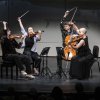
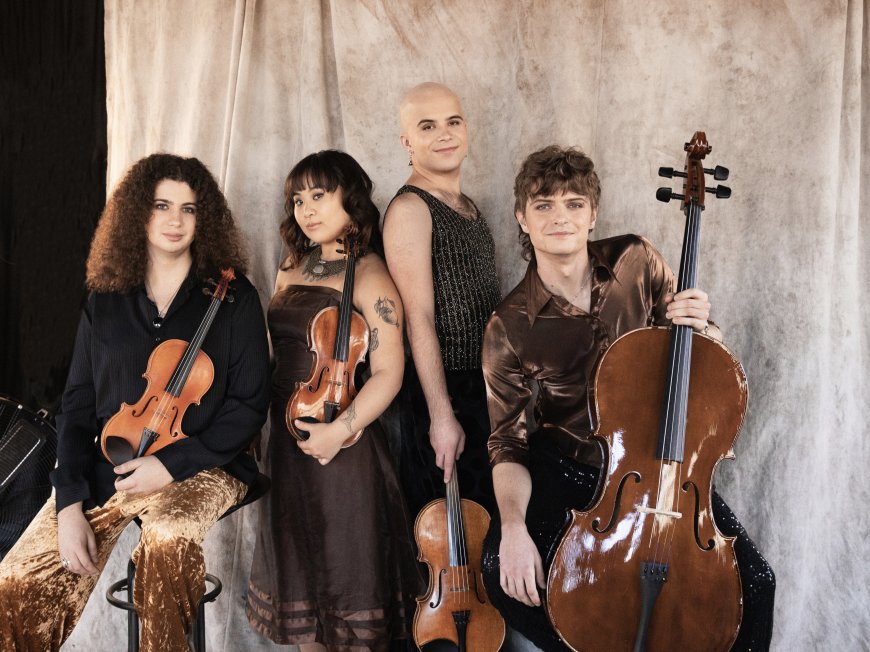
Following a slew of competition wins — including the 2025 Banff International String Quartet Competition – the Poiesis Quartet made its Stanford Live debut at Bing Concert Hall on Sunday, March 8. The magnificently-played program of mostly recent and 20th century music was part of the St. Lawrence Legacy Series
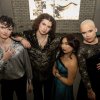
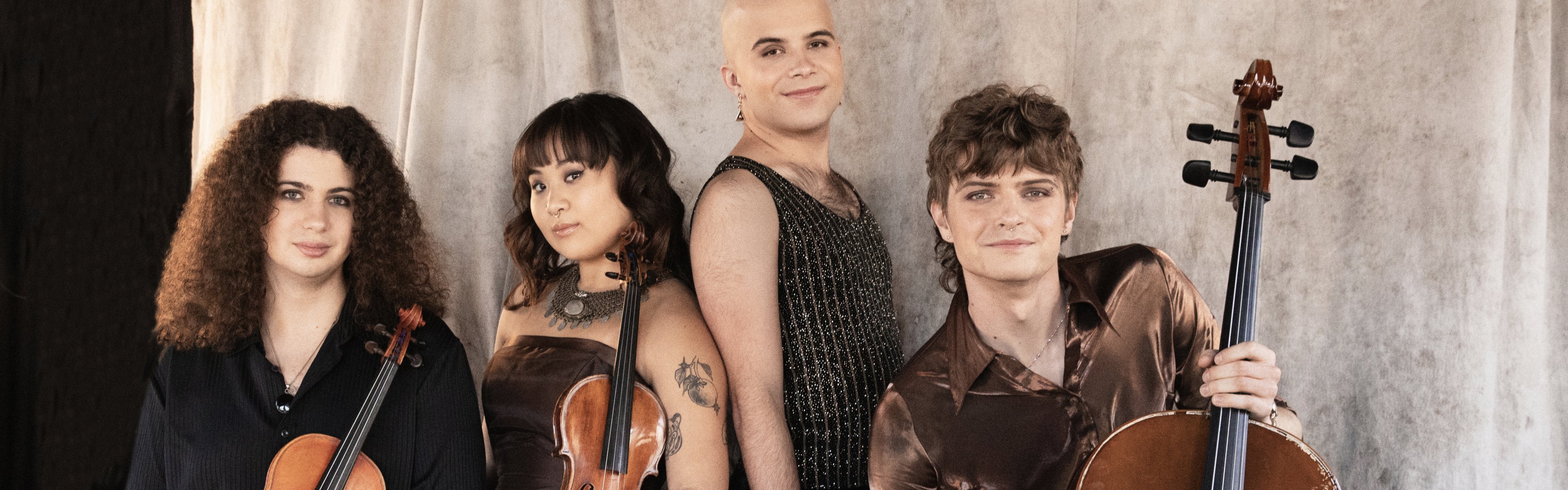
Formed at Oberlin just four years ago, the quartet plays with ferocious intensity and a special kind of artistic unanimity that allows all four voices to always be audible. Queerness is central to their identity, and they present differently from other string quartets.
No uniform long-black here. The musicians perform adorned in an array of sparkles, brocades, and velvets, both harmonious and contrasting. Their concert attire and looks are part of their brand, as much as Yuja Wang’s are part of hers.
The quartet opened their program with Sky Macklay’s 2016 composition “Many Many Cadences.” While the program notes gave a deadpan technical description of the piece, both the composer’s website and Poiesis’s performance make it clear that the work is an extended music joke.
A cadence, as violist Jasper de Boor said to the audience, is a phrase that provides a sense of resolution — think of the final measures of a song or movement. “Many Many Cadences” begins with a tumbling series of terse cadential phrases, running from the instruments’ upper to lower registers, that don’t really resolve. The cello rebels by landing on sustained pitches, soon to be joined by the viola and second violin, leaving the first violin stranded. Hilariously, the music practically stops as the quartet members exchange looks, then resume their headlong progress.
An affectionately played Joseph Haydn quartet, Op. 71, No. 2 in D major, followed. The quartet’s sound grew richer and fuller in this work. The members of the quartet played off each other wonderfully, with all the charm and wit that Haydn needs.
In such a superb concert, every work is a highlight. But if I had to pick just one, it would be the Poiesis Quartet’s first commission — Kevin Lau’s String Quartet No. 7, “Surfacing.” Lau composed “Surfacing” in the wake of a family medical crisis: His infant son was diagnosed with a serious disease, and survived after multiple surgeries and a liver transplant, for which his mother donated part of her own liver. The title of the piece references the experience of emerging from water and being able to breathe again after nearly drowning.
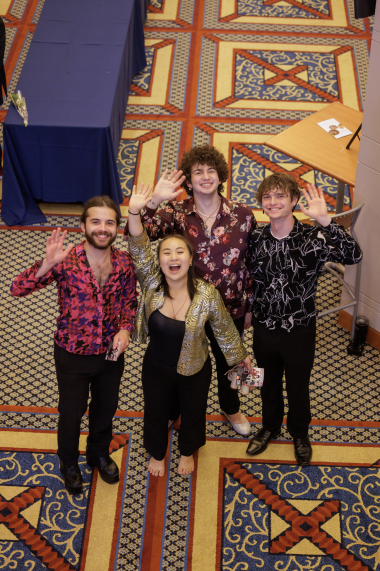
“Surfacing” packs an enormous amount of musical variety into its 14-minutes, yet its multiple changes in mood and style are logical and coherent. It is constructed as a “loose passacaglia,” a form in which a repeated pattern serves as the basis for variations. Max Ball played first violin, a position filled by Sarah Ying Ma for the majority of the program. Their sounds are subtly different, Ball’s perhaps a bit brighter than Ma’s, but both are superb.
In its opening, the first violin soared over the three other voices, as Ball played with improvisatory freedom and beautiful tone. “Surfacing” proceeds through episodes that alternate sweetness with darker, more somber moments. A plaintive solo cello, played with anguished introspection by Drew Dansby, was joined by the viola and then the second violin.
The music shatters, comes together in a hymn-like passage, and shatters again. A fugal section in a major key gives way to an echo of the opening, and a dramatic fade is followed by a rush to the conclusion.
Jerod Impichchaachaaha' Tate’s “Pisachi (Reveal)” for string quartet opened the second half of the program. Tate, a Chickasaw Nation citizen, incorporated Hopi and Pueblo melodies into this 12-minute work, including buffalo and elk dance music.
“Pisachi” originally accompanied a slideshow of images of the Native American southwest, and the music at times evoked the wide-open spaces and endless skies of that region. With sustained tones, trills, and a strummed and plucked solo for the cello, “Pisachi” features moments of hypnotic, almost eerie beauty, that are contrasted with vigorous forward movement.
The program closed with Sergei Prokofiev’s String Quartet No. 2 in F Major. Prokofiev wrote the piece during a time of separation from his first wife, owing to an affair with the much younger woman who became his second wife.
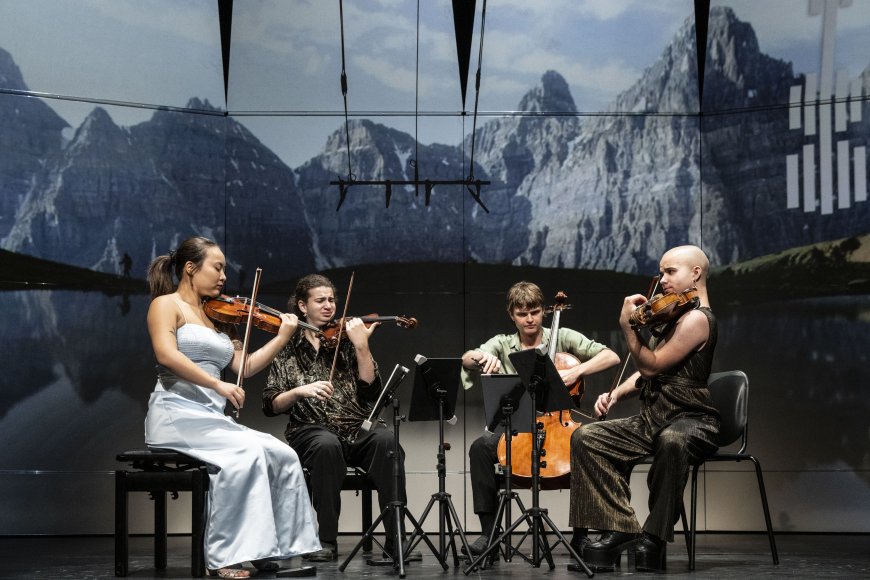
This three-movement quartet includes a first movement in classical sonata form, a lyrical slow movement that Ball described as a “love song in many emotions,” and a rondo based on folk tunes. As with the other works on the program, it received a superb performance.
The Poiesis Quartet now has significant connections with the Bay Area — the group was a 2025 St. Lawrence Emerging String Quartet in Residence at Stanford University and made their local debut at Noe Music in November. We can hope that they’ll return regularly. Their authentic, queer style and intense playing make them a perfect fit for this region.