

Víkingur Ólafsson likes to put together recitals on recordings that connect the dots. Whether the works on the menu seem similar or dissimilar at first, he always finds a way to make things come together — or at least coexist. The Icelandic pianist’s previous release, a recording of J.S. Bach’s now-ubiquitous Goldberg Variations, broke the pattern somewhat by devoting a project to a single work, though you could say that the Goldbergs is a diverse, interrelated universe on its own.
Ólafsson’s latest disc, Opus 109 (Deutsche Grammophon) combines his theme-and-variations experience with the Goldbergs and returns to the connect-the-dots programming in which Bach, his lodestar, joins hands with young Franz Schubert and late-period Beethoven. Another unifying factor is that each of the CD’s six pieces is written in the key of E. As always with this Icelandic iconoclast, the results are thought-provoking and pianistically scintillating.
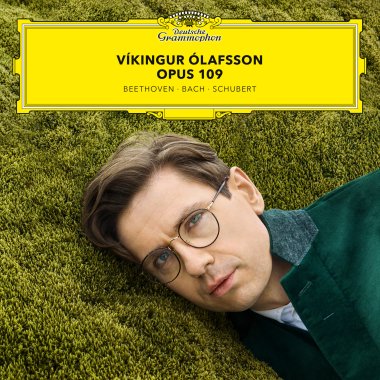
For background, “Opus 109” is Beethoven’s Piano Sonata No. 30 in E major, the first of a trilogy of consecutive opus-numbered sonatas that form his final cosmic testaments of the cycle. But that comes late in this game, for Ólafsson has an arc to construct for context.
Ólafsson starts off with an opening prayer — the brief Prelude in E major from Book I of Bach’s The Well-Tempered Clavier — and from there launches into what he considers to be a prelude to Opus 109 by playing Beethoven’s Op. 90, the Sonata No. 27 in E minor. He makes the strange twists and turns in the first movement stand out even more than they normally do, while not forgetting to caress the consoling tunes of the second movement.
The pianist makes the listener wait a little longer before getting to the main event. For a program that supposedly orbits around Opus 109, placing the large-scale Bach Partita No. 6 in E minor at the middle of this disc makes this piece, rather than Beethoven’s, the recording’s gravitational center. Ólafsson must have chosen it for its quirks and misleading definitions; for example, the Tempo di Gavotta movement is more like a gigue, which he takes at a galloping tempo, and the actual concluding Gigue is really a steadily climbing fugue. Ólafsson’s playing manages to be both liquid and pointed at the same time, with fantastically precise articulation at very fast speeds.
Next comes Schubert’s Sonata in E minor, D. 566, a two-movement beauty that mirrors the structure of Beethoven’s Op. 90. I can hear fleeting post-echoes of the Beethoven Op. 90’s second movement in Schubert’s second movement.
Finally, we hear Opus 109, whose lengthy theme-and-variations finale can be seen, with a little imagination, as a compressed, self-contained, forward- and backward-looking sequel to the Goldberg Variations. Both pieces begin and end with simple, soulful statements of the theme that frame some wild adventures in between. The Sarabande from Bach’s French Suite No. 6 in E major completes the overall arc of the recording with a brief benediction.
This is very creative programming — full of sixes, E’s, overlapping arcs, and links to previous recordings. What will Ólafsson think up next?