Even as San Francisco Ballet turned to the past to pay living tribute to the “Father of American Ballet” in an all-George Balanchine program, the company finds itself smack dab in a problematic present. The causes are twofold and have now mingled.
First, in declining to cancel a May engagement at the Washington, D.C., Kennedy Center — now rebranded the Trump-Kennedy Center — the Ballet is at odds with numerous other companies and individual artists who have refused, on principle, to perform at a storied venue President Trump has seized in order to take control of its programming.
Then came the passionate reaction, by eloquent critics and online commenters, to SFB including an excerpt from Balanchine’s 1958 Stars and Stripes on the company’s Jan. 14 opening night gala program, complete with the concluding reveal of an enormous American flag behind the dancers. The full piece closed the Feb. 10–15 Balanchine bill at the War Memorial Opera House.
Context matters: art doesn’t occur in a vacuum, disconnected from time and place. What Balanchine, a Russian émigré, created as an ebullient patriotic salute to his new artistically nourishing home in the U.S. is today at best disquieting and at worst deeply dissonant with the mood of a divided country beset by images of militarized, deadly combat in American cities.
The result of these two commingled issues is a company that seems an outlier, politically and ideologically. It will take time for the damage to fade and heal.
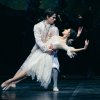
If anyone was mulling all this at the Wednesday, Feb. 11 performance, Balanchine’s transporting Serenade must have suspended such thoughts, as it did for me. The first ballet Balanchine created in America is a masterpiece, and it got a gorgeous, deeply felt performance, staged by Sandra Jennings.
Set to Tchaikovsky’s rapturous Serenade for Strings, with the sequence of the four movements tellingly altered, the piece opens with a haunting mystery: Why are those 17 women raising their straightened arms, as if to shield themselves from the sun or some other bright celestial manifestation? If this tableau, reprised twice during the piece, is never explained, Balanchine gives us something much richer — a plotless skein of interwoven patterns, at once beautiful and beguiling.
When those arms first relax, they do so in gently bending curves, like branches yielding to a soft wind. With the dancers’ legs slightly blurred in long filmy blue skirts, the choreography makes their arms a recurring delight. At one point the dancers assume the fifth position, arms arched above their heads, and lean in such a way as to conjure trefoil leaves or blossoms. Later, the dancers travel en pointe together, their backs to the audience so we can see their arms tightly linked in sisterhood across their backs. They form loose daisy chains and softly beat the air with swimming motions.
In a superb cast, Misa Kuranaga and Fernando Caratallá floated and soared through their waltz meters. Madeline Woo was a dynamic sensation in the principal solo role. using her arms to torque her tight, electric spins. In lifts she seemed to change direction in midair, whipping her gaze from left to right and back. She also collapsed, a great dancer suddenly brought low. It was a dramatic, disarming moment, one of several heightened by conductor Martin West’s sensitive rubatos.
Serenade closes with “Elegy” — this is where Tchaikovsky’s languorous, brooding slow movement is shifted to fashion an eerie, ambiguously consoling ending. With his eyes covered by an Angel (Kamryn Baldwin), her arms winged out behind him, one of the few men in the ballet (Myles Thatcher) is unmasked to perform a sacred duty. A word that ought to be used sparingly fully applies here: This Serenade was transcendent.
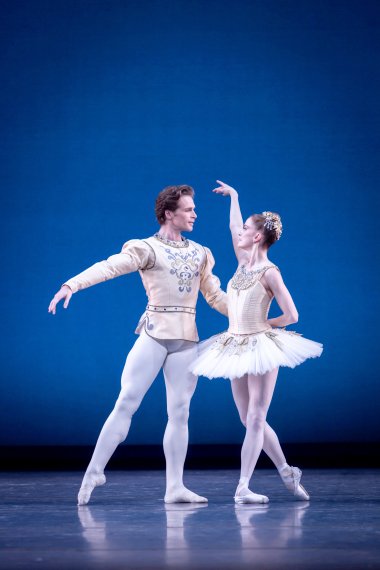
The program opened with Diamonds, one panel from the full-length Jewels. Danced with careful attention to every step and detail, the piece unfolded like an extended essay in fractals — one group of three dancers combining with another, those six breaking into trios of twos and so on. With costumes studded with flashing faux-diamonds, the piece had a surface glamour that wasn’t matched by the rather tidy, deliberate, and tiresome progression of the piece, set to a swatch of Tchaikovsky’s Symphony No. 3. Frances Chung and Joseph Walsh were alluring as the lead couple, but they never quite animated the choreography that kept pulling them apart and bringing them together from distant corners of the stage.
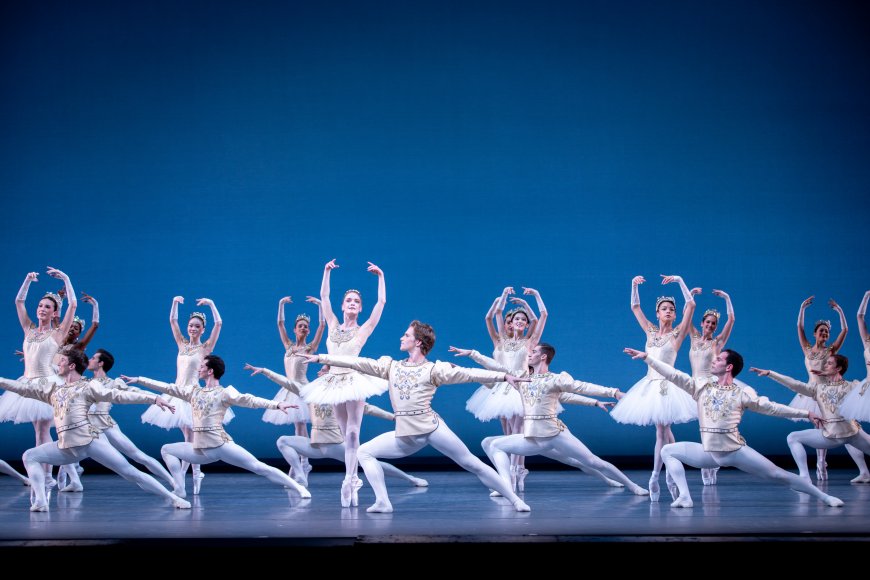
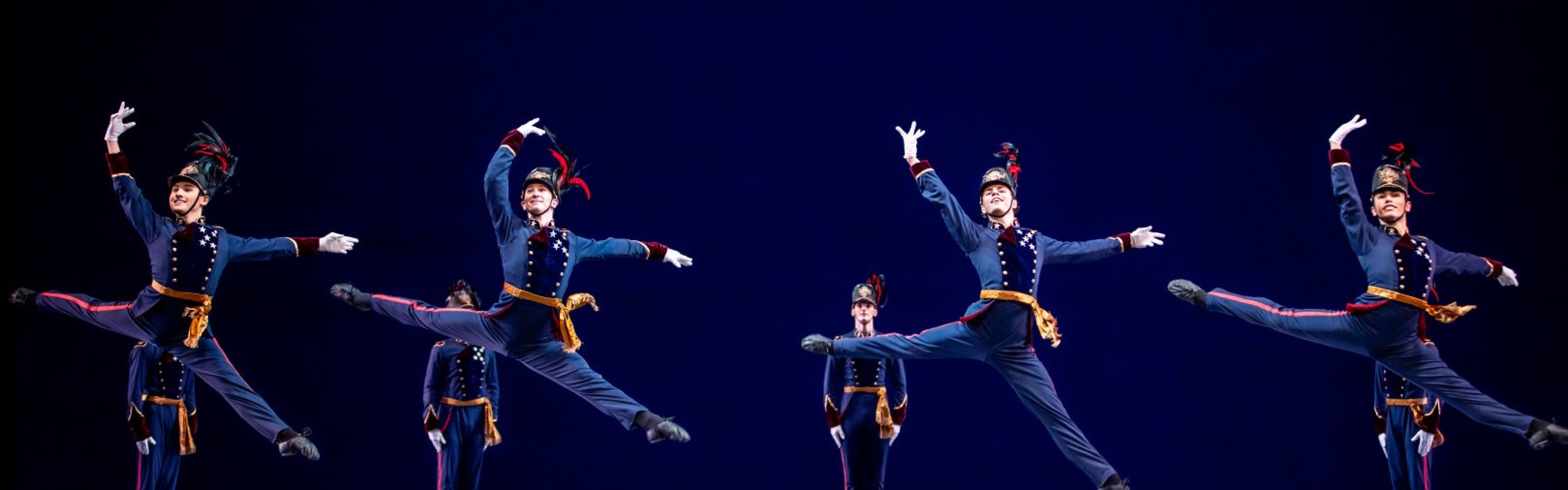
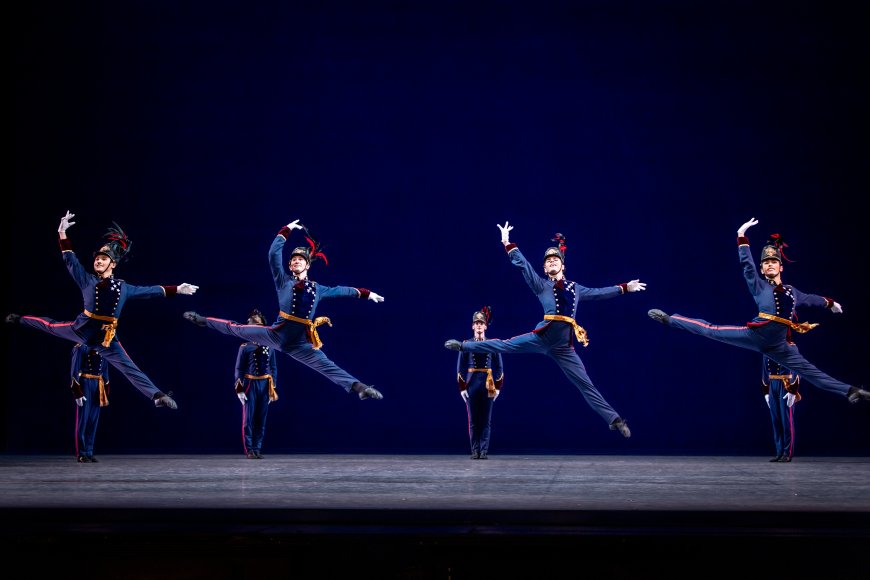
With the closing Stars and Stripes, it was time to strike up the band with John Philip Sousa marches. As sheer spectacle, the piece is one volcanic eruption after another of crisp steps, Day-Glo tutus, and endless volleys of stiff-spined salutes. I thought the men took best-in-show honors with their spring-loaded toy-soldier jumps and spins. Cavan Conley was their fleet, able captain. The finale is a feat of high-energy traffic control. It all felt like a time capsule from an America that exists only as a kind of retrograde fantasy now.
At the curtain calls, the dancers waved little flags, presumably from their country of origin, heritage, or identification. Three days after the Puerto Rican rapper Bad Bunny’s triumphant Super Bowl halftime show, the flags were like a small, game echo of his thrilling assertion of a truly pluralistic America – or rather Americas, including everything north and south, and of a U.S. grappling with what it is and whatever it might become.