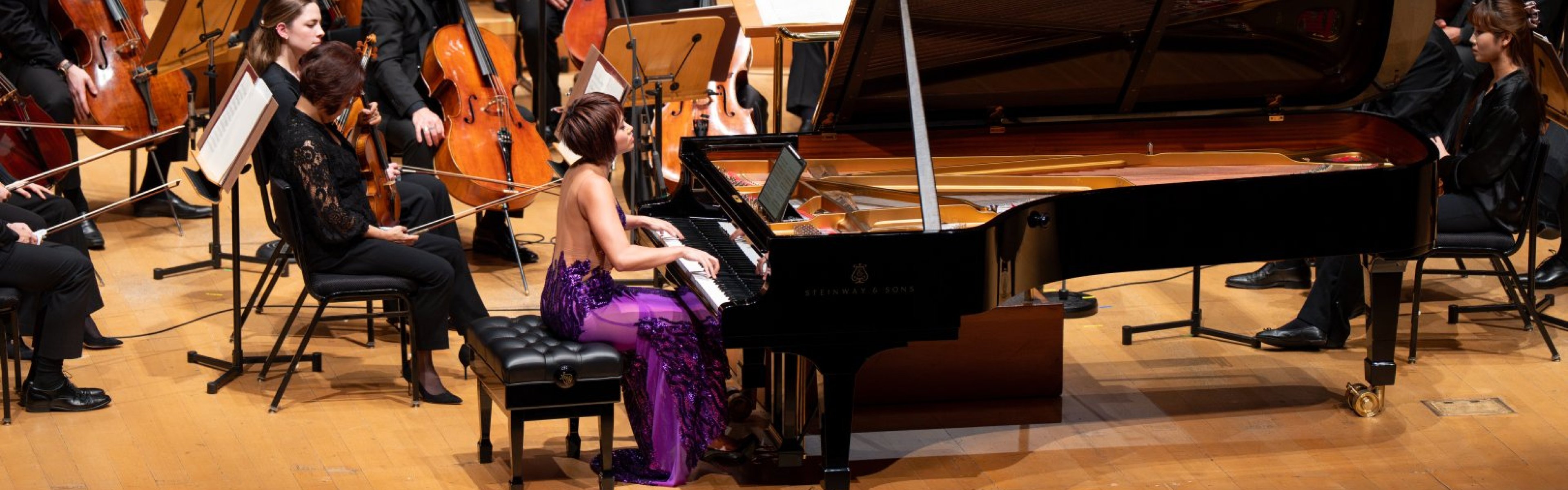
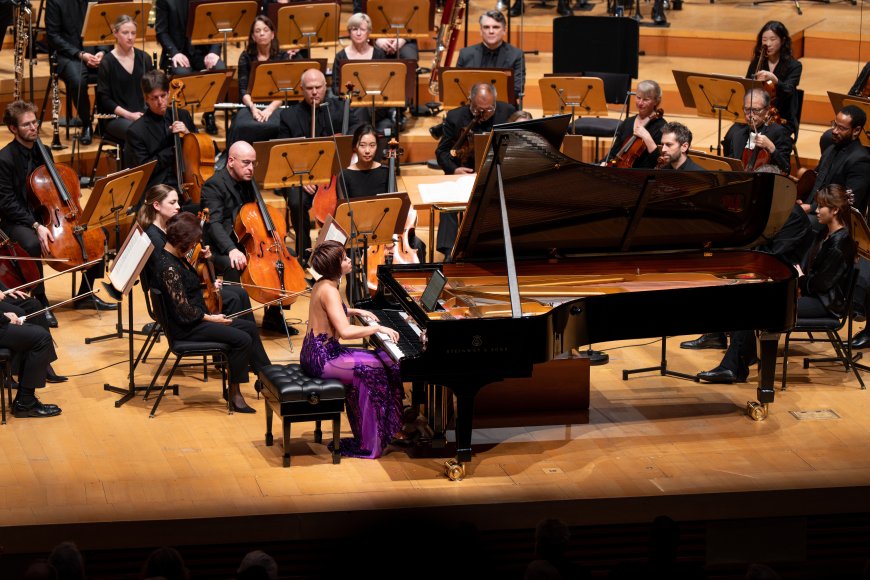
Piano superstar Yuja Wang, composer-conductor Thomas Adès, and an inspired Los Angeles Philharmonic brought down the house at Disney Hall on Friday with a wonderfully noisy program.
The spectacular show — enjoyed by a packed audience — was anchored by Wang’s exhilarating performance of Sergei Prokofiev’s propulsive, impossibly difficult Piano Concerto No. 2. Two other weighty works — Tchaikovsky’s incendiary symphonic fantasia, Francesca da Rimini, and the LA Phil premiere of Adès’s dense orchestral suite, Aquifer (2024) — had the orchestra playing at full tilt. Adès, a familiar and welcome guest, drew precise and richly detailed playing from the Phil, which has been in top form in recent weeks.
Audiences expect a dramatic entrance from Yuja Wang, and she did not disappoint, striding on stage in a backless purple dress. Her provocative outfit matched the bold, rebellious, and youthful spirit of Prokofiev’s Second Concerto, one of the most challenging in the repertoire.
For my rubles, the Second is the greatest of Prokofiev’s five piano concertos, in which the composer clashes his “Scythian” writing with calm and meditative episodes. Rarely silent, the pianist negotiates two giant cadenzas (the first marked Colossale) and endless speedy passages all over the keyboard. In 1913, a near-scandal erupted in response to its aggressive dissonance and “futurism” when Prokofiev premiered the work in Russia. “We can hear music like this from our cats at home,” a critic of the time wrote.
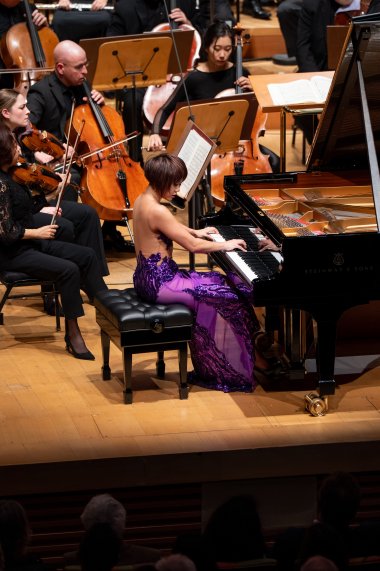
Even today, the Second Concerto sounds remarkably modern and progressive. Wang revels in the work’s keyboard acrobatics and stresses its more raucous elements. But her tender account of the soulful opening storytelling theme and the Russian tune in the finale cast a magical spell.
Wang has performed the piece for years and recorded it with Gustavo Dudamel and the Simón Bolívar Symphony Orchestra of Venezuela. Through all the abrupt rhythmic changes and tricky transitions, Adès followed Wang’s lead. With only a few bumpy moments, he kept soloist and orchestra together. When the marathon had ended, Wang rose and fanned her face in mock exhaustion.
The tumultuous standing ovation persuaded Wang to supply not one, not two, but three encores. First came a favorite of Dudamel’s, the sultry Danzón No. 2 by Arturo Márquez (transcribed by Leticia Gómez-Tagle). Eric Satie’s flippant Trois morceaux en forme de poire: En plus followed, played with four hands by Wang and Adès. Wang finished with Russian pianist Samuil Feinberg’s finger-twisting arrangement of the third movement of Tchaikovsky’s Sixth Symphony.
The U.S. premiere of William Marsey’s suite Man with Limp Wrist provided a gentle prelude, opening the evening. Commissioned by the LA Phil and championed around Europe by Adès, this suite responds to eight paintings by Salman Toor, a Pakistani American artist whose work explores the lives of queer South Asian men. Each section draws on “melodies and harmonies from centuries-old hymns, breaking down and reassembling them into fragments that repeat, meditate, and unravel,” Marsey writes.
The piece deconstructs and rearranges a Bach Passion hymn, dance forms, folk tunes, and brass fanfares. Marsey likes the oboe, and LA Phil’s Ryan Roberts made the most of those lyrical moments. Ingratiating and delicate, Man with Limp Wrist may well prove to be one of those rare new works that will find a standard place in the repertoire.
Adès’s love for Dante, who inspired his 2021 ballet The Dante Project, ignited his passionate interpretation of Tchaikovsky’s Francesca da Rimini — as a closeted homosexual, Tchaikovsky identified strongly with the conflicting emotions of the sinning lovers, Paolo and Francesca, as told in Canto V of Dante’s Inferno.
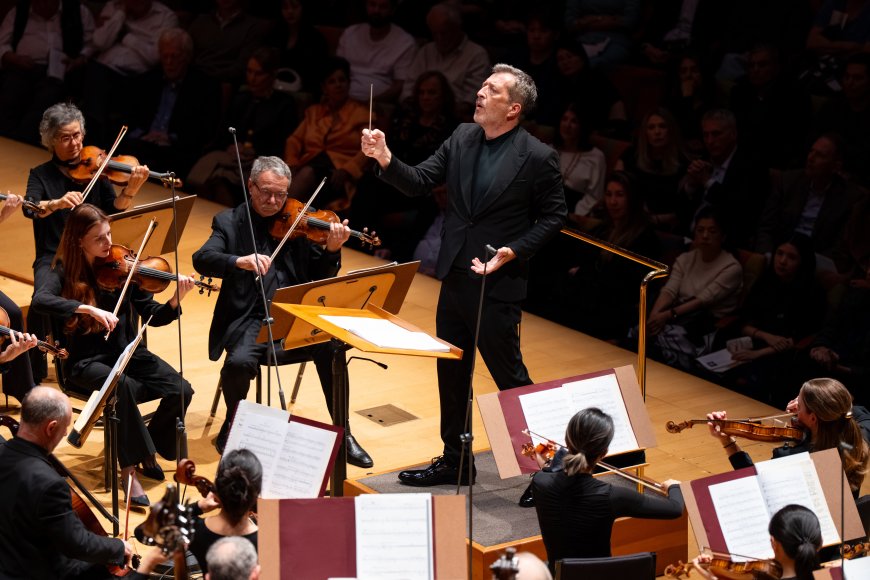
Brooding and dark, the work opens with a tritone interval, setting the stage for tragedy. It then moves to a cinematic illustration of the relentless wind that whips around the adulterers. Their love theme takes time to appear, a gently falling melody that clarinetist Boris Allakhverdyan delivered with a melting beauty. The brass provided chilling, hellish fanfares.
Adès’s new work, Aquifer, concluded the lengthy evening. The composer-conductor employs a titanic orchestra, with an expanded percussion section featuring damaged bell plates, sizzle cymbal, clash cymbals, hi-hat, metal scaffolding bars, and a rattle for the final measures. In seven uninterrupted sections, Aquifer explores images — mostly loud and surging — of water flowing underground. Giant waves of sound wash over us, enormous and threatening, prehistoric in their power and majesty.
It was a night to remember.