Oftentimes I wonder after hearing a piece of new music at its world premiere whether it will withstand repetition — that is, assuming that it will be repeated at all. A piece might make an immediately strong first impression yet fade upon second or third hearing.
But I don’t think there will be much danger of Gabriela Ortiz’s six-act magnum opus, Revolución diamantina, fading. I heard the world premiere at Walt Disney Concert Hall in November 2023 during the California Festival, then heard the subsequently-released, digital-only Platoon recording from those concerts, and listened again. And again. I’ve gotten the same thrill each time, which doesn’t often happen with new music.
Revolución diamantina, named after and inspired by the “Glitter Revolution” that took place in Mexico in 2019, is a barn burner of a piece — dynamic, irresistibly grooving (as is often Ortiz’s signature), and an orchestral tour de force. So far, it is the crowning achievement of Gustavo Dudamel’s Pan-American Music Initiative — and I hope it sticks around after he leaves the Los Angeles Philharmonic this summer.
As he makes his way down memory lane in these final few months after 17 seasons with the LA Phil, Dudamel chose to reprise Ortiz’s piece Thursday night, Feb. 26, as part of a Beethoven concert series in which three of the four programs pair works by the classical master with pieces from our times.
This pairing is a perfect match, for Beethoven was a sometime freedom fighter in his music and Revolución diamantina dramatizes feminist protests in Mexico City against police brutality. That theme also resonates with our ICE-infested times here in the U.S. and with the subjugation of women throughout the world.
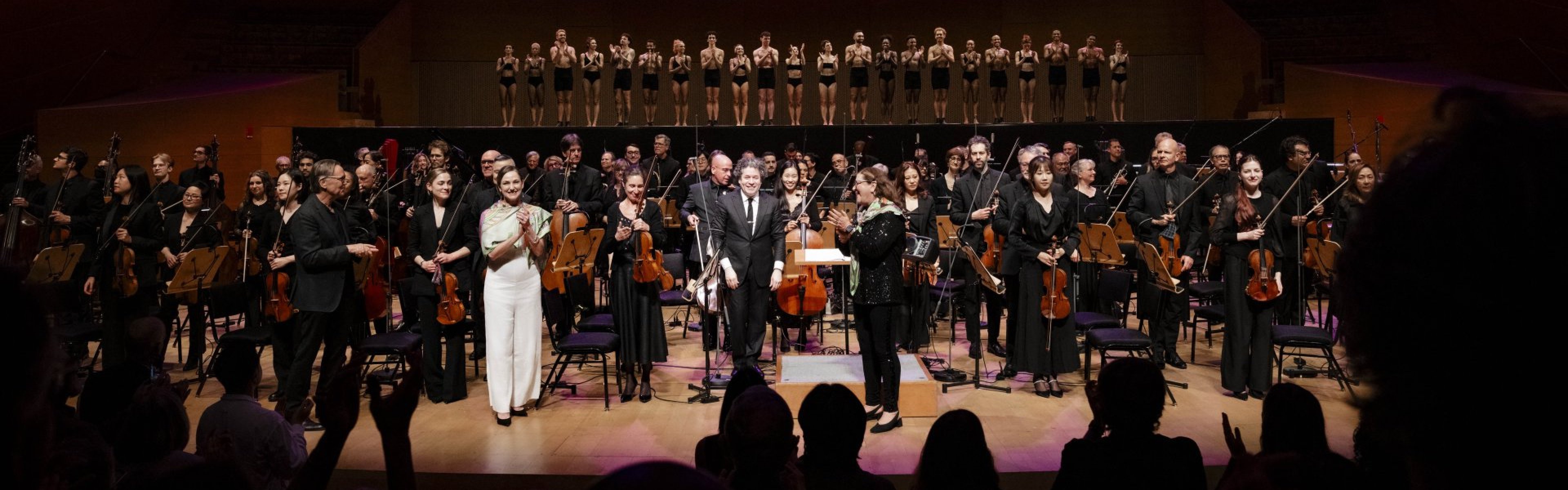
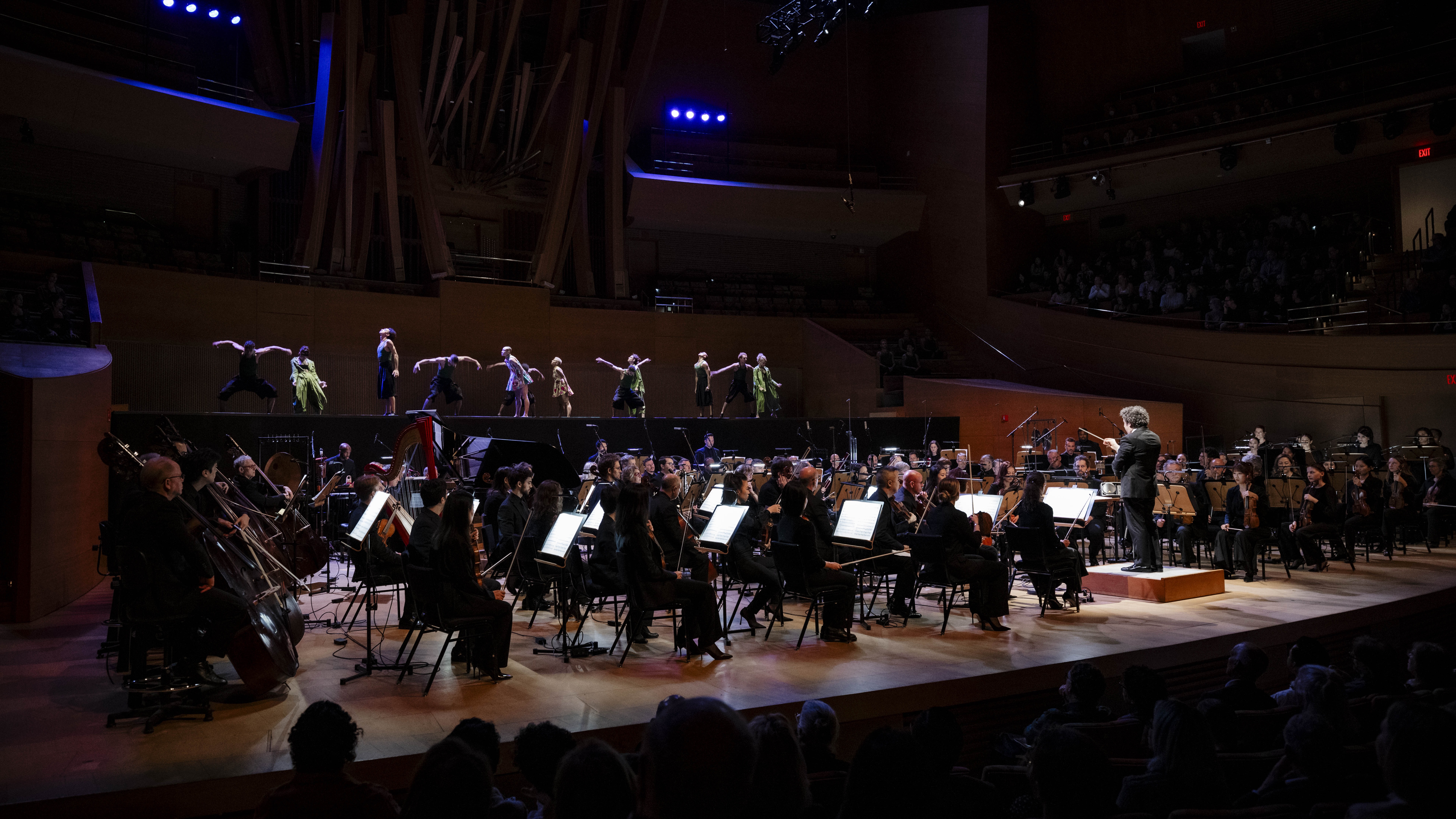
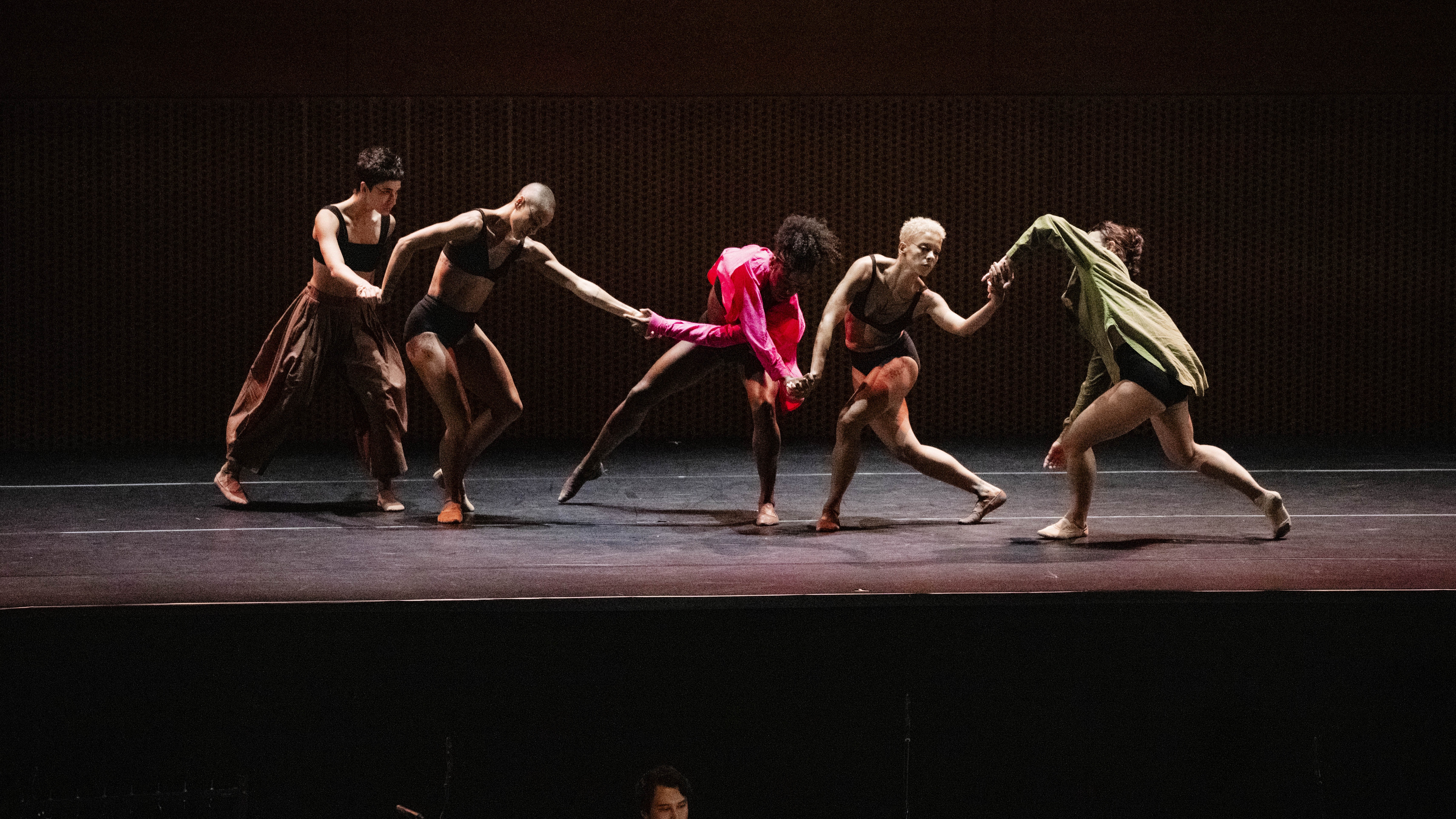
This time, Dudamel added dancers to the mix, thus fulfilling Ortiz’s vision of Revolución diamantina as a ballet. The dancers were an agile, fluid, half-clothed group of 22 men and women from the Brazilian dance troupe Grupo Corpo, choreographed by Rodrigo Pederneiras and Cassi Abranches. Two other Pederneirases, Paulo and Gabriel, did the lighting design. Placed on an elevated stage behind the LA Phil, the dancers’ routines gradually grew more horrifying, depicting the sexual violence that sparked the real-world protest movement. In the final movement, the dancers appeared together, moving slowly and nearly in unison as a hopeful gesture of unity and justice.
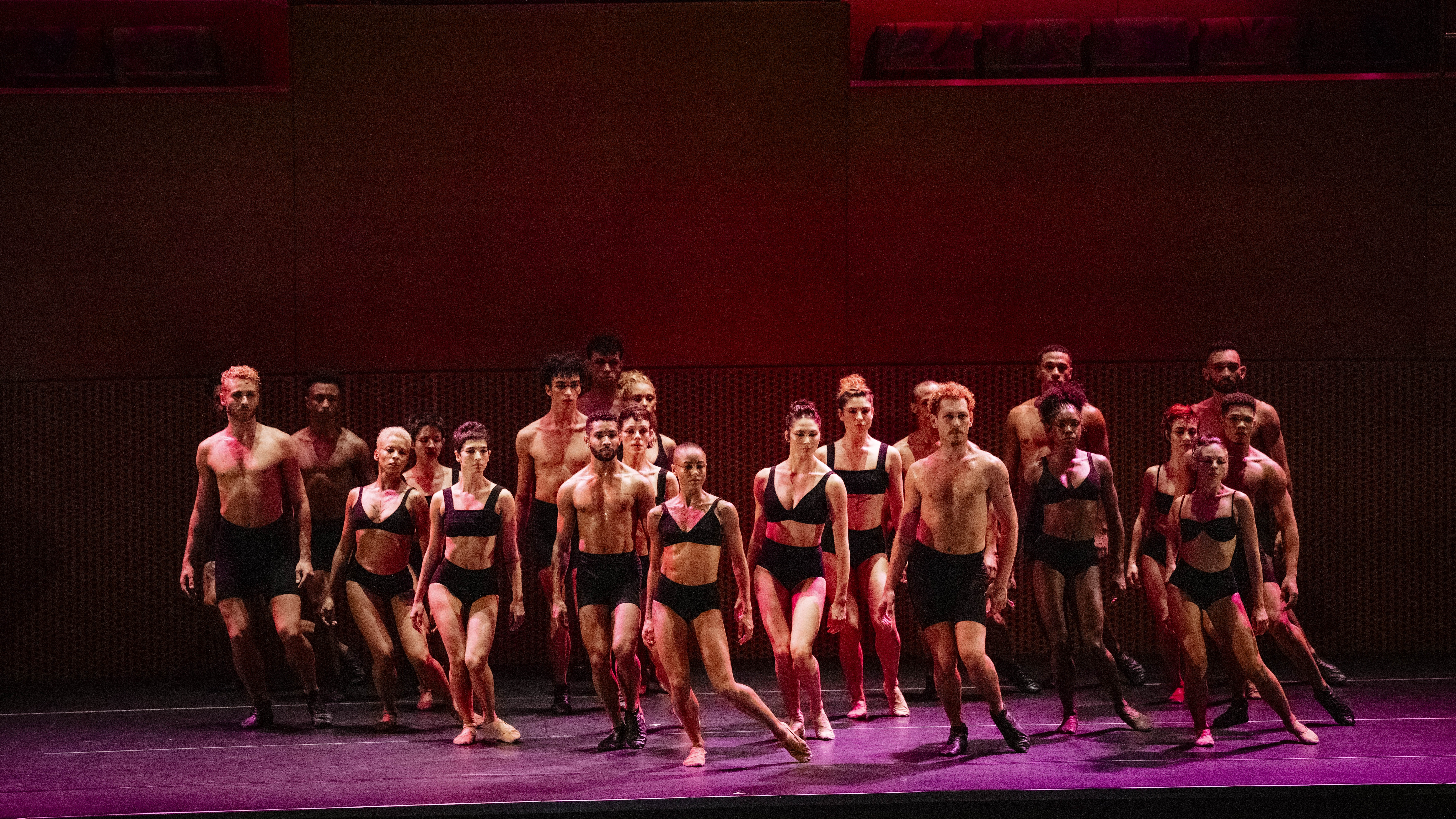
The visual activity transformed the score’s effect. It began to feel like high quality dance music, an instigator, observer of, and commentator on the action onstage, as well as an orchestral showpiece.
It was clear that Dudamel could feel the rhythms and excitement in his bones, and he could also dig deeper into the ominous implications of the score with Grupo Corpo’s dancers providing context. The borrowings from Igor Stravinsky’s The Rite Of Spring in Acts 3 and 4 were obvious — and this time, I thought I heard other brief references to diverse other pieces, like Carl Orff’s Carmina Burana.
The program book listed a massive arsenal of 44 different percussion instruments, which kept the piece’s grooves going. The most innovative “percussion” instruments of all were the eight female singers from the Los Angeles Master Chorale who were mostly asked to rhythmically scat, shout, and exult, resorting to real words and slogans only in Act 5.
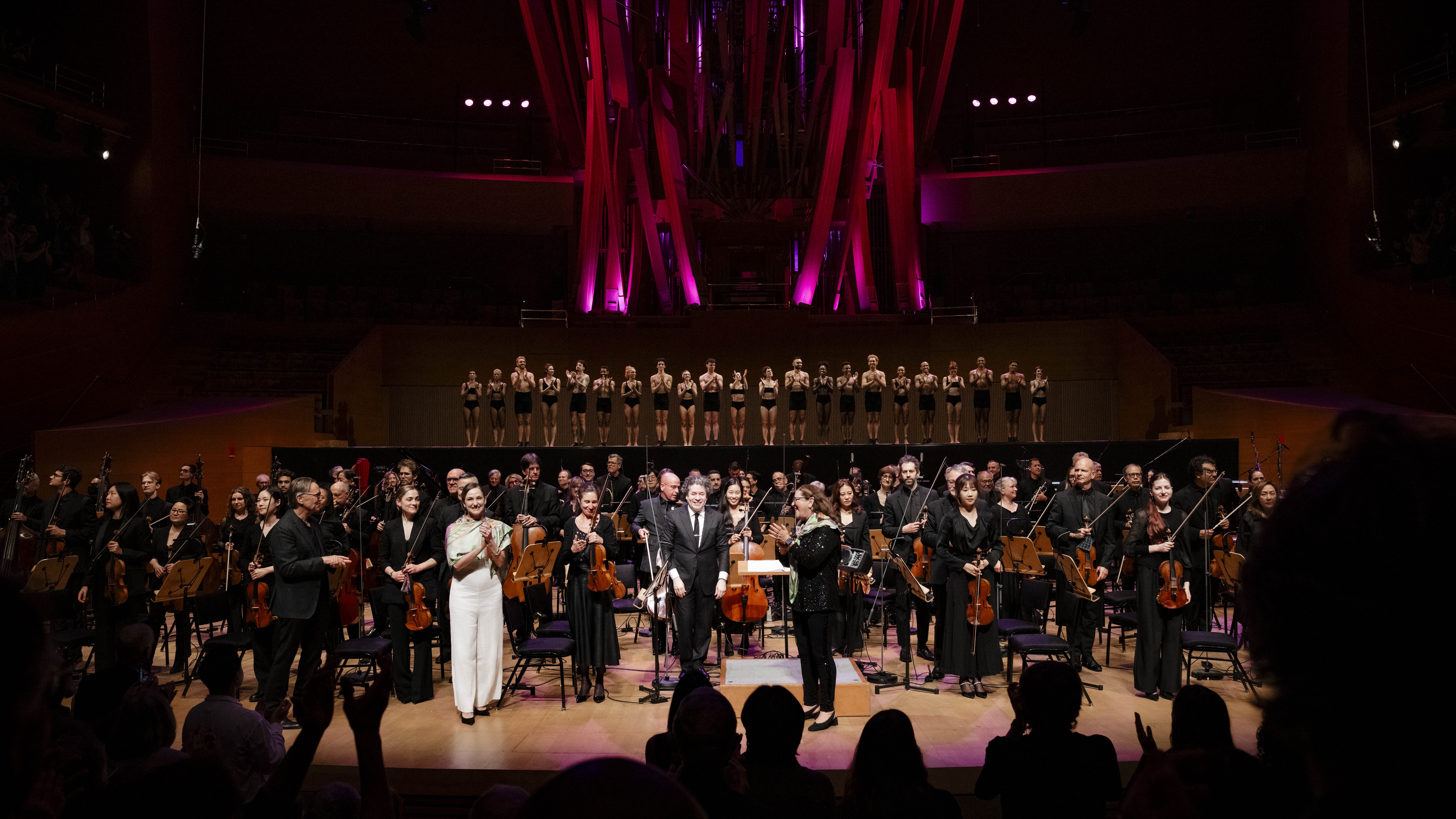
However, the vocalists in this performance did not make as big an impact as the singers do on the recording. The amplification, coupled with the acoustics of the hall, smoothed the voices out, burying them so that they blended into the orchestra instead of standing out in sharp, irresistibly percussive relief.
Beethoven’s slot in the program was occupied by the Symphony No. 7, which could be linked to Ortiz’s ballet if you accept Wagner’s dictum about the Seventh being “the apotheosis of the dance.” Dudamel’s vision for the work — which hasn’t altered much since he performed it on his debut recording for Deutsche Grammophon in 2006 — isn’t so much a dance as it is a rough-edged, visceral tussle with fast tempos in three of the four movements.
There is more grace in the quieter moments now, and the Finale doesn’t race quite as insanely fast as it did when Dudamel was a Venezuelan fireball in his 20s. But it’s still a wild, feisty ride — and he had a sturdy vehicle to drive in the LA Phil.