What is beauty? And how do beauty and tension coexist?
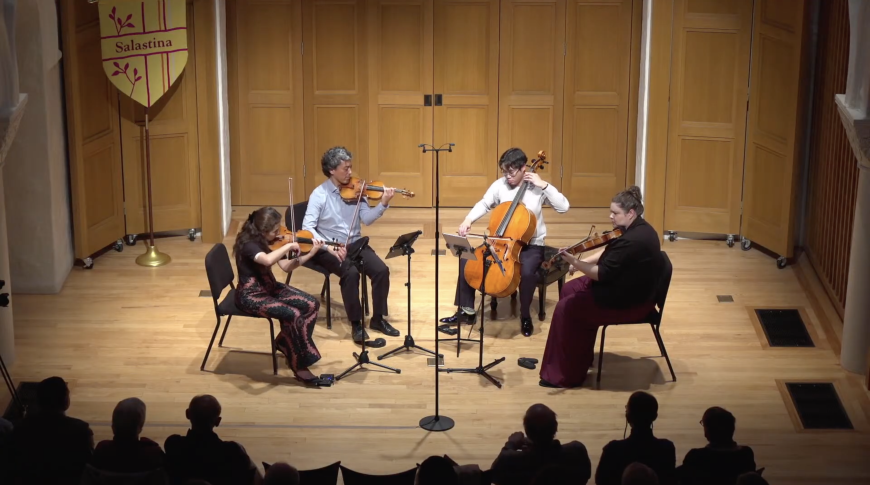
These are weighty questions, and Salastina, the always surprising chamber ensemble, sought to answer them in a concert last weekend in Barrett Hall at the Pasadena Conservatory of Music. Its imaginative and passionately performed program of 11 pieces ranging from 1611 to 2016 didn't supply any definitive answers, of course. But there was ample food for thought, and some dazzling music-making along the way.
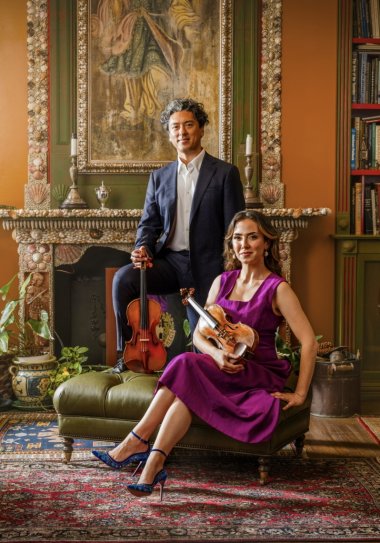
Founded in 2010 by violinists Kevin Kumar and Maia Jasper White, Salastina calls itself “a 21st-century reimagining of the chamber music salon” that “invests equally in the classics and the generation of new music." Concerts are held in small, intimate spaces that encourage conversation between the audience and the performers.
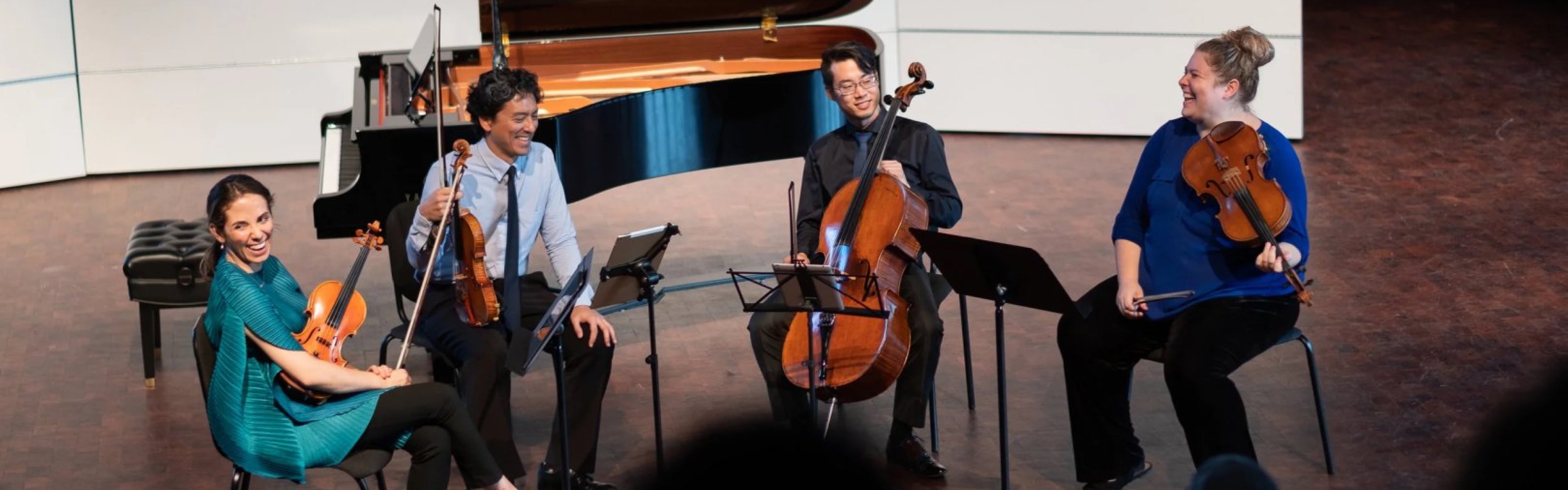
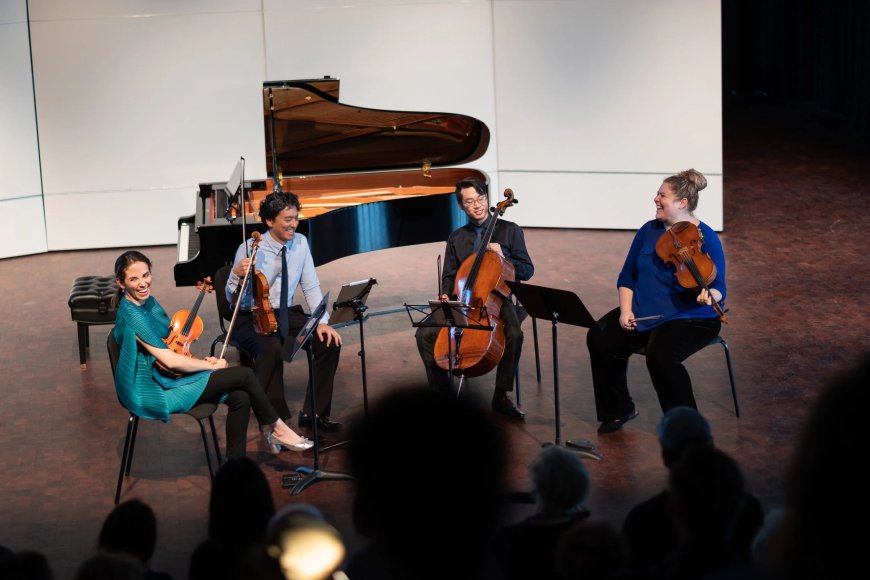
Resident Host and Artistic Partner Brian Lauritzen, a DJ at KUSC classical radio, provided chatty commentary and guidance at the Nov. 14 concert. He joined the string quartet of Kumar, White, violist Meredith Crawford, and cellist Yoshika Masuda onstage at regular intervals. Even the program notes were designed differently: “This music hurts so good” was one of the comments.
The evening connected single movements from larger pieces, carefully assembled to illustrate contrast, continuity, and the theme “Beauty in Tension.” The result was a vibrant multicolored collage of styles, techniques, and voices, a “journey of friction, feeling, and release.”
Classics by Carlo Gesualdo, Mozart, Leoš Janáček, Sergei Prokofiev, and (almost classic) Ruth Crawford Seeger rubbed shoulders with music by contemporary composers Christopher Theofanidis, Caroline Shaw, and Paul Wiancko. Barriers between centuries and individuals dissolved, revealing shared traits of music from all ages.
Theofanidis’s “YOUMEONE” from Visions and Miracles (1997), a mostly serene reflection based on the simple C major scale, underpinned by Masuda’s glowing cello tone, brought us gently into the conversation. Echoes of the opening Prelude of Bach’s Well-Tempered Clavier, Book I, hovered in the background. Without pausing, the players launched into the famously weird first movement of Mozart’s String Quartet No. 19 (“Dissonant,” 1785), whose radical opening section sounds as if it could have been written yesterday (or even in the future). Resolution finally comes, with the return of Mozart's more familiar "classical" voice.
A different sort of tension — thwarted romantic desire — informs Janáček’s string quartet Intimate Letters (1928). Inspired by Janáček’s longtime infatuation with Kamila Stösslová, the piece veers between lush romanticism and jagged angularity. Kumar led with confident precision, by turns aggressive and sweet. Here, and throughout the evening, the four players communicated with an ease and balance gained from long experience together.
Samuel Barber’s Adagio for Strings, from his String Quartet No. 1 (1936), creates tension through the deafening silences that follow moments of searing anguish and dramatic climax. Salastina wisely underplayed the melodrama. The first movement from Sergei Prokofiev's tart and rustic Second String Quartet (1941) cleared the air, playfully dissonant and thorny. Written while Prokofiev was living in evacuation in the Caucasus during World War II, it draws upon the dance-like folk music of the region.
Maia Jasper White’s arrangement of Gesualdo's madrigal “Beltà poi che t’assenti” (“Fair one as you leave me,” 1611) asserts that beauty is inseparable from pain. Salastina’s incendiary performance of the dark and angst-filled Andante from Ruth Crawford Seeger's Quartet 1931 seemed to prove that point, seething with harmonic friction and sublime tension.
Charles Ives shared with Seeger a proudly contrarian musical personality. In "Arguments," the second movement of his String Quartet No. 2 (1913), four musicians squabble, talking over each other in a futile attempt to find common ground. “Echo” and “Nimrod,” two movements from Caroline Shaw's more serene and comforting Three Essays (2016–18) provided emotional relief.
For the finale, Salastina dove into the rich choral sonorities of Paul Wiancko’s Glacial-Maniacal-Lift (2016). Here, and throughout the evening, the players showed fine intonation, poetic phrasing, and polish.
All the musicians played on instruments crafted by Mario Miralles, a local maker who lost his entire studio in the Altadena wildfires. Acknowledged from the stage, Miralles stood to receive a warm ovation. The concert’s soothing message, sent to him and the audience, was that beauty can arise from the ashes of discord and loss