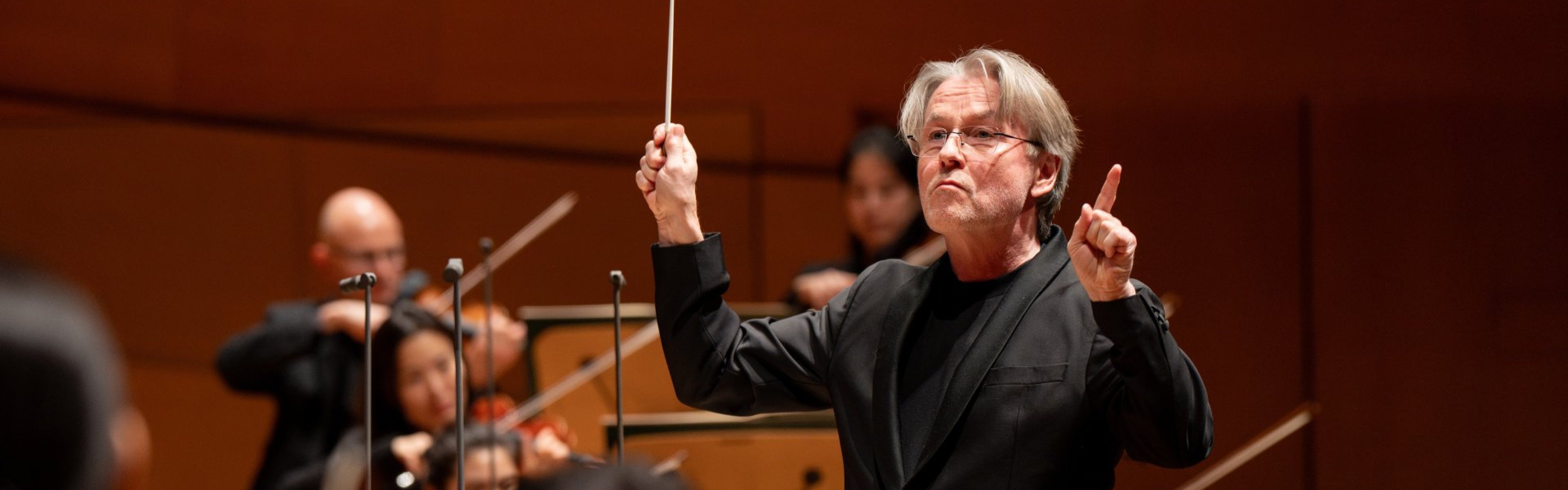
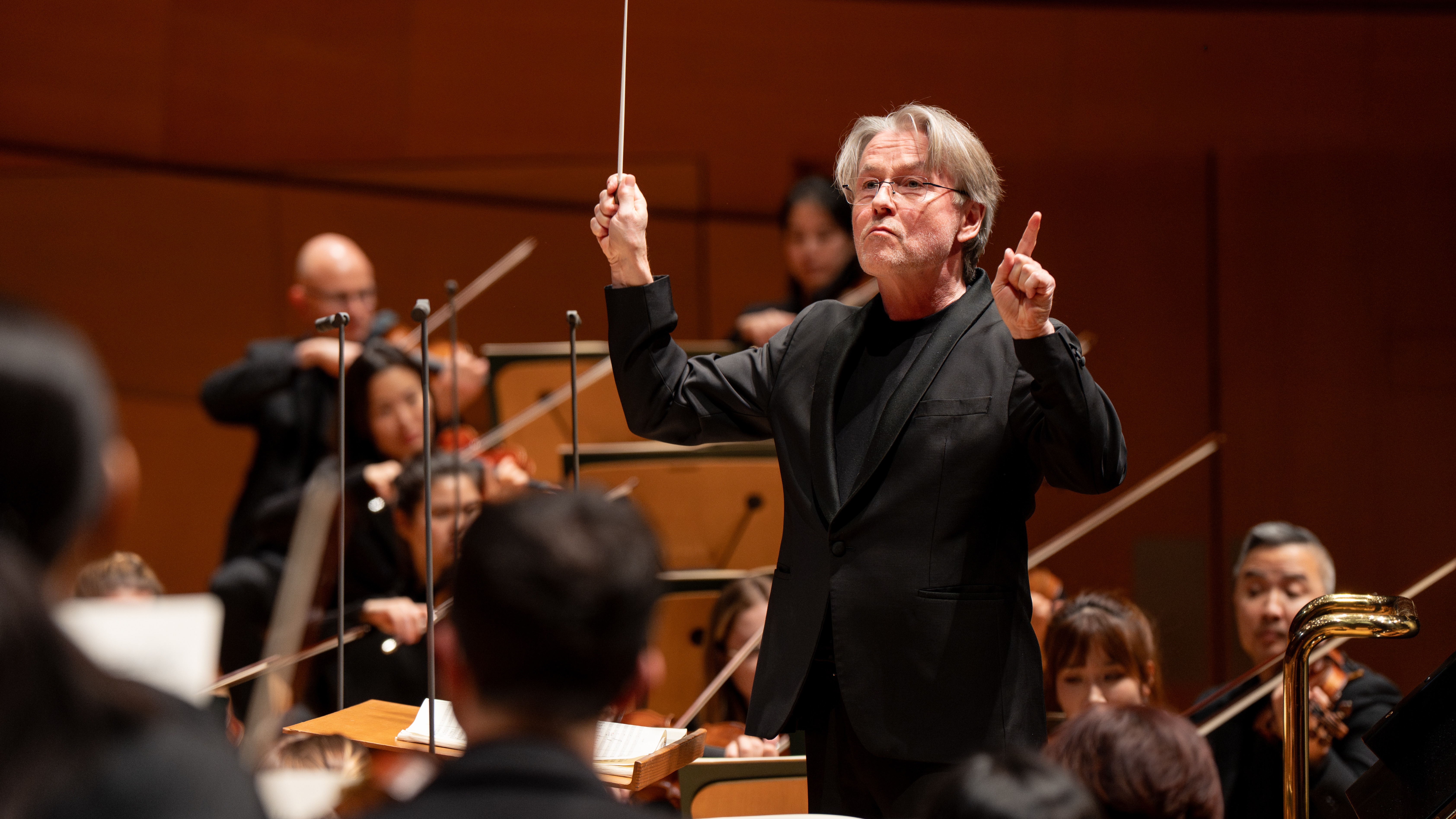
Esa-Pekka Salonen doesn’t officially become the Los Angeles Philharmonic’s first Creative Director until the orchestra’s 2026–2027 season. But his January concert appearances at his old stomping grounds sure felt like the de facto start of his new job, even though the programs were worked out well before his appointment was announced.
As always whenever Salonen conducts in Walt Disney Concert Hall, adventure was in the air. Only one piece was on the program Sunday afternoon Jan. 18, but it was a monster that did not need any companions: Ferruccio Busoni’s huge, rarely-performed, and intensely strange Piano Concerto in C Major, the longest piano concerto in the canon. You could say that Busoni’s work is the piano concerto equivalent of Gustav Mahler’s gigantic Second and Eighth Symphonies or J.S. Bach’s St. Matthew Passion, or Richard Wagner’s Ring cycle.
Salonen and the boundary-pushing pianist Igor Levit — who joined him in the performance — are old hands at tackling Busoni’s monster of a concerto, having done so in 2023 when Salonen was still the music director of the San Francisco Symphony. But the LA Phil had never played it before, nor surely had most of the audience at the Jan. 18 concert ever heard it live. There are over a dozen recordings now of the 1904 work, but none came out until 1967 when John Ogdon (another iconoclastic pianist), Busoni scholar Daniell Revenaugh, and London’s Royal Philharmonic took a crack at it.
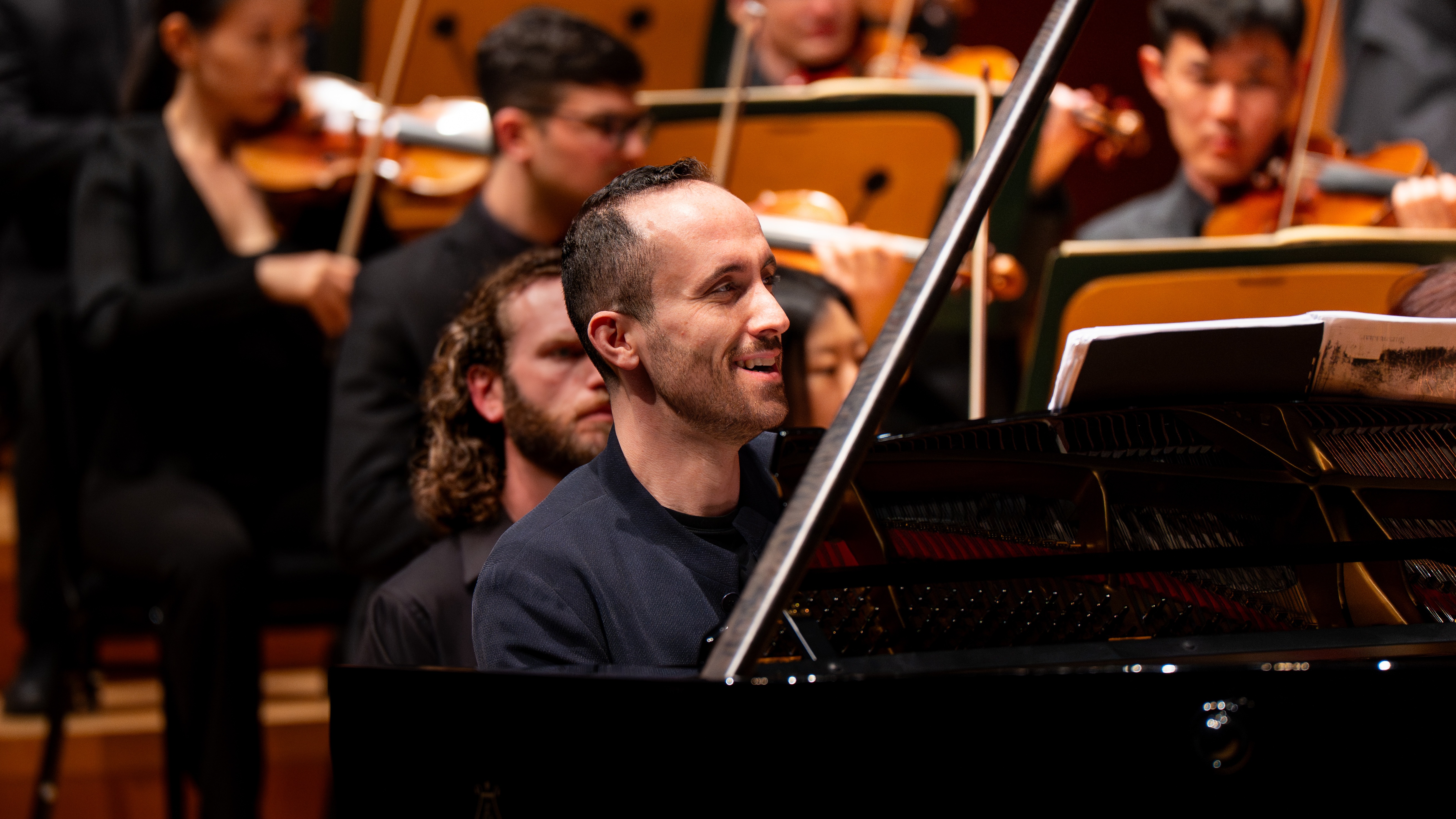
Salonen has said that while having dinner with Levit many years ago, they casually decided to perform the concerto, without knowing quite what they had gotten themselves into. Busoni’s structure is a daunting marathon, approximately 70 minutes long depending upon the tempos. The piece has three thoughtful, mostly monumental movements and two whimsical, rhythmically energetic movements.
The piano part is unbelievably difficult, as per the reputedly stupendous keyboard technique of its composer. The long, flowing orchestral introduction seems to take its cues from Brahms, but before long, Busoni can be heard straddling many dual worlds — Germany and Italy, logic and mysticism, the 19th and 20th centuries, classical poise and Romantic rapture, ivory-tower vistas and wild Italian street music. The last movement features a male chorus (shades of Beethoven’s Choral Fantasy) that — after sitting still for an hour — solemnly intones in German a poem by Danish writer Adam Oehlenschläger, “Hymn To Allah,” taken from his play Aladdin, or the Wonderful Lamp. What all the words mean is unclear, but it makes a predictably grand, closing impression as pure sound.
The Philharmonic publicity machine went out on a limb to plug Busoni’s unicorn of a concerto as a “masterpiece,” a judgment that was vigorously disputed when the piece was new and continues to be debated to this day. Yet after hearing Salonen and Levit go at it, I’m now inclined to side with those who believe it is truly a masterpiece. The work reveals its full stature when heard live in an electrifying performance like this one, with a first-class orchestra in an acoustically detailed hall.
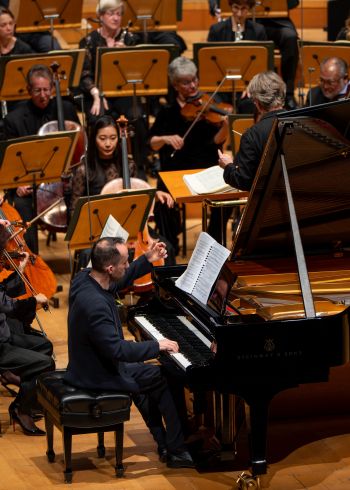
The ensemble that Salonen used was smaller than I expected, yet all the better to catch the wealth of detail and strangeness of harmony as the work pushes onward — and Salonen had no trouble summoning waves of elemental power. Levit could be imposing and bombastic when needed, his thundering octaves and chromatic chords competing with the loud brasses on a roughly equal basis, while taking care to make the delicate passages tinkle and sparkle.
The first movement, pushed hard in tempo, melded almost unnoticeably into the second with virtually no pause. The super-tarantella that drives the fourth movement was a dashing, bacchanalian carnival that caught fire and hell in their hands, with Levit’s cadenzas sounding almost recklessly and deliciously modern in their noise and fury.
Though Busoni called for the chorus to be invisible, in this performance, the 46 men from the Los Angeles Master Chorale were all-too-visibly facing everyone in the hall from the rear of the orchestra. Instead of a mystical faraway sound, we instead got a rich, full, heavy dose of male voices that frankly sounded glorious.
Salonen is back at the LA Phil – albeit jumping the gun a bit, but I don’t mind. With the conductor peaking as an interpreter and programmer as he enters his senior years, it promises to be a stimulating ride.