Performing music faithfully to the way it was played in its own era is something of a mirage. We live in the now, and so do our performances. But when scholarship meets master musicianship, a deeply satisfying and entertaining experience can unfold.
That’s why you want to visit Voices of Music, the chamber group whose Valentine’s Day concert of love songs and instrumentals from the 17th century was a highlight of the Bay Area’s music calendar last weekend.
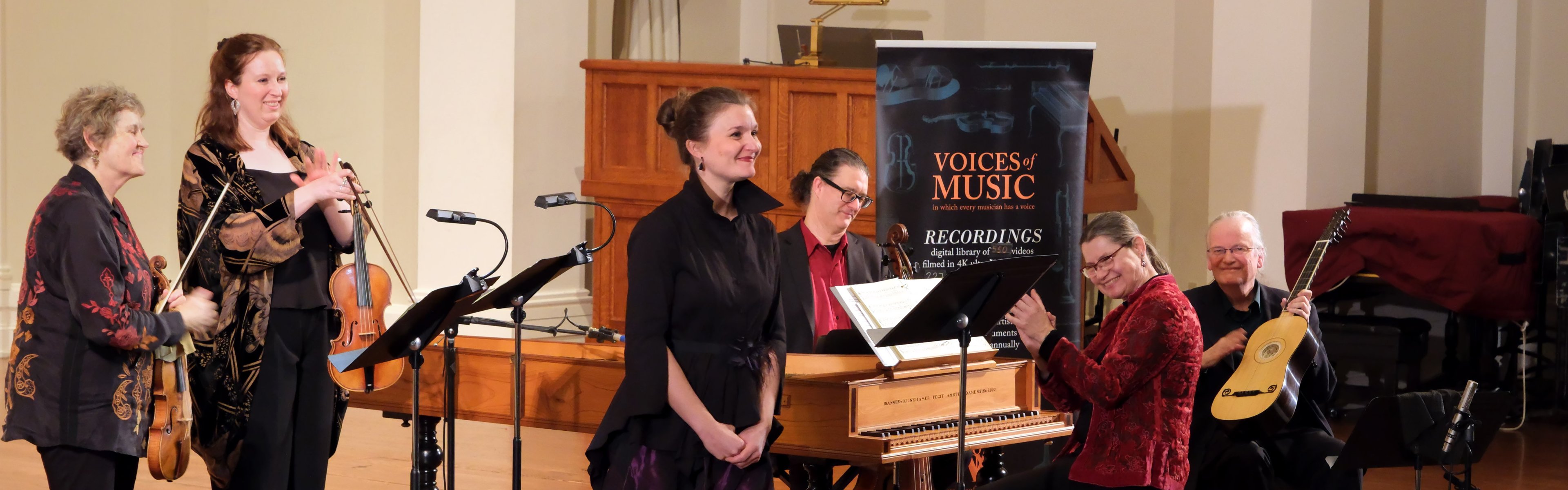
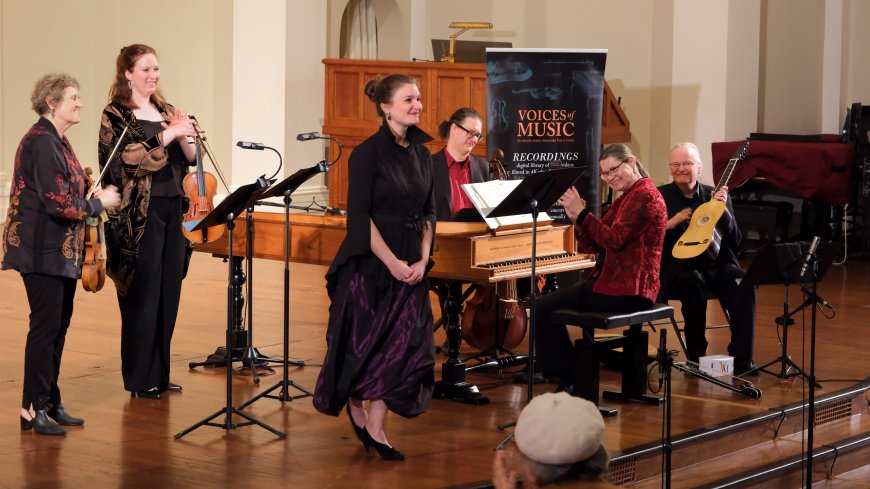
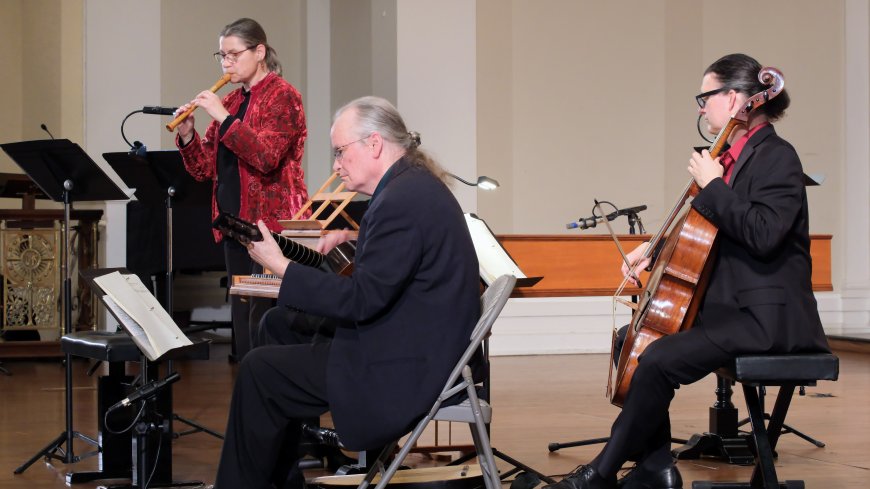
The musicians — harpsichordist/recorder player Hanneke van Proosdij, lutenist David Tayler, violinists Elizabeth Blumenstock and Augusta McKay Lodge, cellist William Skeen, and soprano Danielle Reutter-Harrah — know each other so well that the music pours out naturally. They’re all so well-versed in style and musical character that tempo changes occur without pause or obvious signaling from anyone, even when they’re quicksilver fast, as in Francisco Turini’s Sonata “Il Corisino.”
“We just listen to each other,” said van Proosdij after Sunday’s concert at First Congregational Church of Berkeley. “It was different last night. We like to live on the edge.”
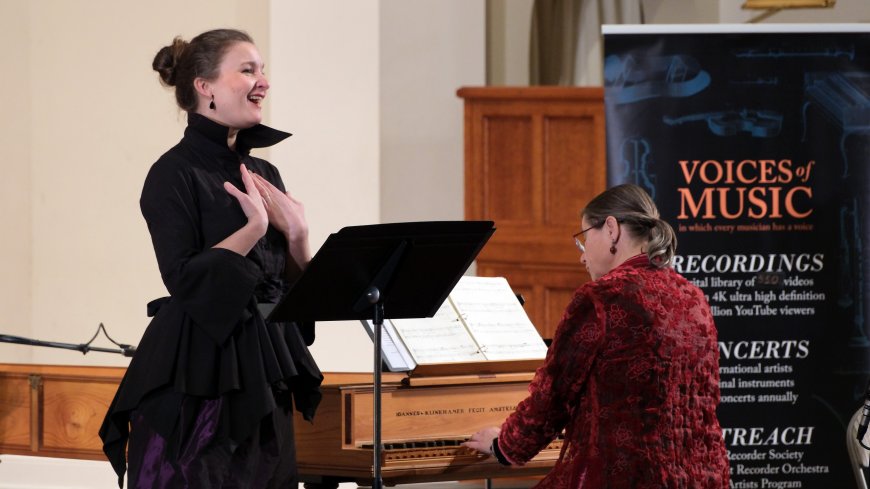
Reutter-Harrah, a late substitution for the originally scheduled soprano Amanda Forsythe, was at her best in two dramatic numbers, Eurydice’s aria “Mio ben” from Luigi Rossi’s Orfeo (1647), and Barbara Strozzi’s lament “Che si può fare?” (What can I do, 1664).
Strozzi’s surprisingly modern sounding song, with its affecting melody set over a descending four-note ground (repeating bass line), hits listeners with an immediacy that doesn’t need translation. Reutter-Harrah made a strong case for a simple, direct approach to the piece — she relies on the cumulative power of repetition, unlike other singers who tend to embellish or give more differentiated interpretations. Reutter-Harrah’s was easily the best of the performances I’ve heard.
“Mio ben” requires a little more oomph, and Reutter-Harrah built the aria to a dramatic climax in a natural, unaffected way, with the emotion concentrated in the plangent vocal line. In the more “artsy” and complex “Welcome, welcome ev’ry guest” (John Blow, 1700), the soprano’s superb diction was a virtuosic display in itself. Her vocal flexibility also made a feast out of the little-known but delightful “Accenti queruli” (Complaints) by the singer Giovanni Felice Sances.
Some of the evening’s most conventionally romantic moments, which naturally require two people, were performed by the violinists. Blumenstock and Lodge matched their tone and traded sensuous, longing phrases in two sonatas by Henry Purcell, and in an imaginative trio sonata by Marco Uccellini.
Meanwhile, cellist Skeen made a meal of the 17th century’s delight in singable, wide-ranging bass lines. The versatile van Proosdij took up her recorder for a couple of divisions (variations) on dance tunes, which ended with finger-gnarling, flashy passagework, carried out with her usual aplomb.
The concert’s scholarship was apparent in its 16-page program, filled with notes about the pieces and prints of the original scores. Thanks to audience curiosity about the instruments, we learned, from Blumenstock, about how the length of the bow and the number of bow hairs increased through the 17th century (partly to create a bigger sound). From Skeen, we heard about the five-stringed violoncello piccolo.
The ultimate point of the evening, even one as draped in primary sources as this one, was to provide a lighthearted concert for Valentine’s Day. There was no Hallmark-card sentiment here — just a variety of diverting, tuneful music performed with wit, grace, and understanding.