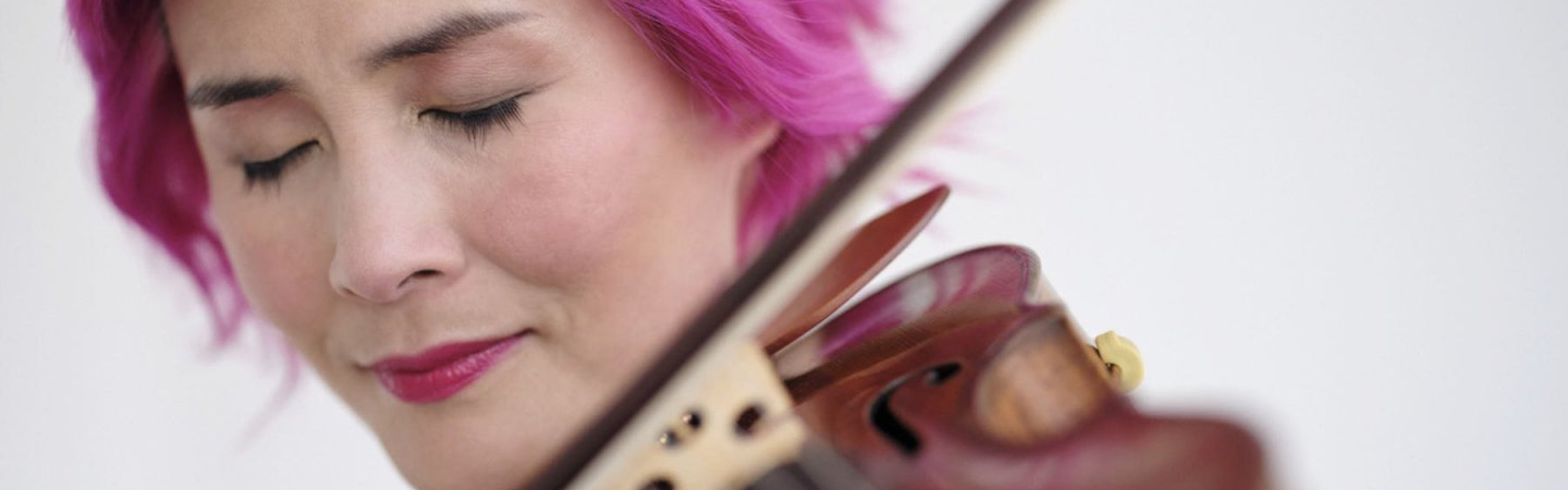
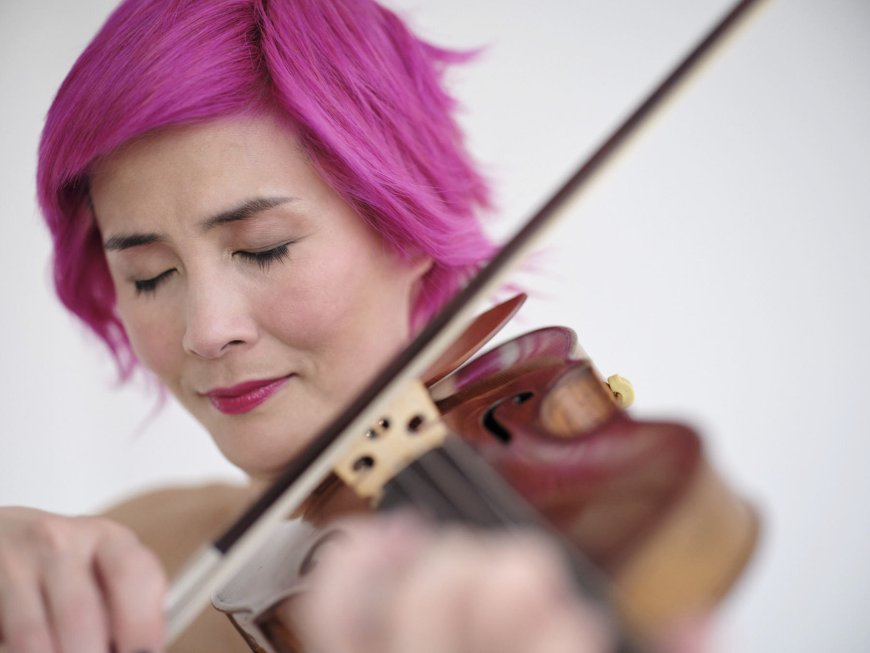
Long before violinist Jennifer Koh won a Grammy Award, her parents were refugees from North Korea.
They landed in Glen Ellyn, Illinois, where Koh was born and raised. After signing their daughter up for violin lessons, Koh went on to win the International Tchaikovsky Competition in Moscow, Russia at age 16. She then attended Oberlin College, where she studied literature and worked with violinists Felix Galimir and Jamie Laredo.
Koh was named Musical America’s 2016 Instrumentalist of the Year, won the Concert Artists Guild Competition, and received an Avery Fisher Career Grant. Alongside her own career as a violinist, Koh has worked to give opportunities to other musicians.
In addition to founding the ARCO Collaborative, a nonprofit that amplifies underrepresented voices in classical music, her other initiatives include Alone Together, Bach and Beyond, Bridge to Beethoven, and The American Concerto. Fiercely committed to contemporary composers, during her three-year tenure as artistic director for Fortas Chamber Music Concerts at the Kennedy Center, the organization commissioned more than 40 new compositions.
At Herbst Theatre on Feb. 20, San Francisco Performances presents Koh in recital with pianist Thomas Sauer. The program includes works by Lili Boulanger, Kaija Saariaho, Ravel, Fauré, and Tania León.
Ahead of her San Francisco engagement, the violinist spoke with SF Classical Voice about her interest in literature, contemporary music, and putting her family’s story onstage.
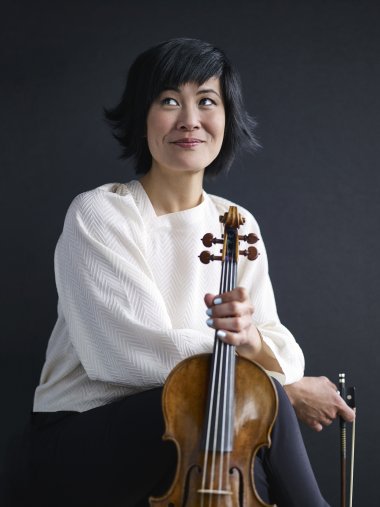
I read your family wasn’t musical. How did you come to play the violin?
I come from a family of refugees from North Korea. Over the course of the Korean War, my mom walked from North Korea all the way to the southern tip of Busan over several years. When they came here to the U.S., they wanted me to have everything that they didn't have. That included violin, but it was also ice skating, swimming, diving, rhythmic gymnastics, gymnastics — it covered all of these different things.
When they went to the local music school, violin was the only opening so that's why I played the violin. I was incredibly lucky because I had a wonderful violin teacher, Mrs. Davis, who was my first violin teacher. I'm still close with her, and she just had her 94th birthday.
Looking at your various projects, it seems you prioritize supporting those underrepresented in classical music. Does that have to do with being from a family of refugees, and the chances you had?
Music is a space to hear voices that we don't hear, and I feel like it's important to make space for people that haven't been heard traditionally. For myself, I always find it more interesting to hear other people's ideas than my own because I already know my own ideas, and I know my own experience.
I did a project with Davóne Tines called “Everything Rises,” which was the first time that I had advocated for myself and my own story, and it was the first time that a Korean American experience had been put on a classical music stage. It was mostly a story about my mom and her experience in the war, and Davóne’s grandmother, and our matriarch histories in our families. I do think it's important to bring forward stories that haven't been heard before.
Where does your commitment to contemporary music come from?
You don't know any repertoire when you first start a musical instrument. It's something you learn over the course of your life. I had probably played all of the standard repertoire by the time I was 17; it just seemed really weird to stop learning things.
I also had teachers and mentors who had worked very closely with composers. One of my teachers was Felix Galimir and he premiered a great number of works of [Arnold] Schoenberg and [Alban] Berg and [Anton] Webern, and he had played for [Maurice] Ravel even. And then Jamie Laredo was my teacher as well. The kind of knowledge that both Jamie and Felix had from having worked with those composers, and the passing of that knowledge to the next generation like myself, is just amazing.
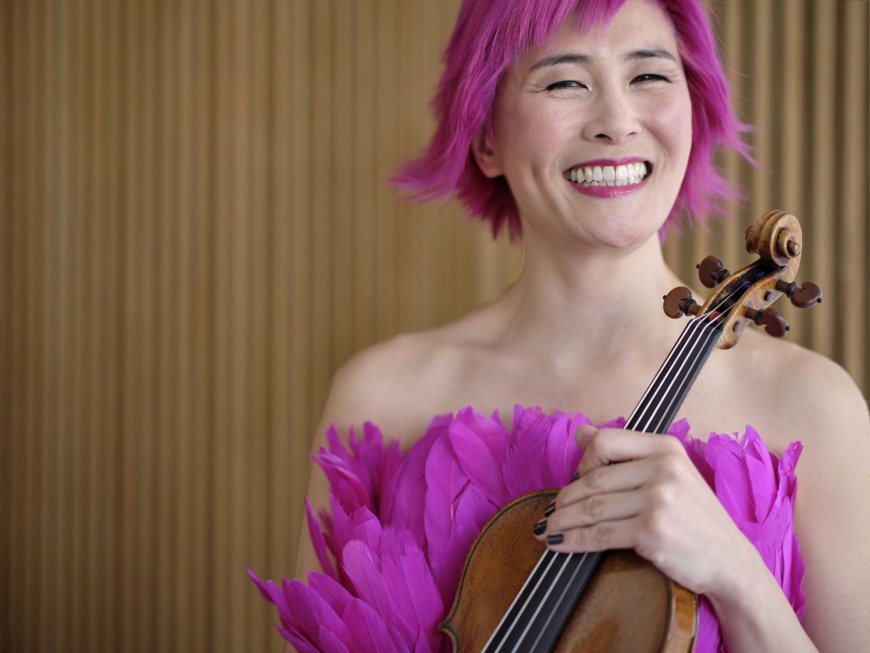
For me it has become incredibly important to be able to make space for others, for their voices to be heard. That's why I advocate so much for contemporary music. I also think it changes the way that we listen to older music because it changes the frame and the context of how we engage with those older works.
I was an English major, a literature major, and you’re always analyzing older works through new lenses of thought and philosophy. [As a student], I understood that there were multiple lenses [through which] to look at older works — historicism, new historicism, colonialism, Marxism, deconstructionism. It also seemed to me, on a very fundamental level, it would be weird to like only read newspapers from the 18th century. I want to engage with the world around me now, and I want to do it through an art form that I love.
Why did you study literature?
It was something I always had felt close to. When I was younger, I liked music and reading and swimming, and then later I realized, “Oh, those are all solitary activities.” I was on the swim team, but even then, you're still in the water alone. At that time, I won the Tchaikovsky Competition — I was 16 years old.
I had gone to college very, very young — I went when I was 16. I'm grateful that I chose to do that at that time, because I knew I needed to grow up and I didn't want to completely 100% focus on only one thing at that point. I'm so grateful that I did have that broader learning experience, because it taught me to learn things in different ways.
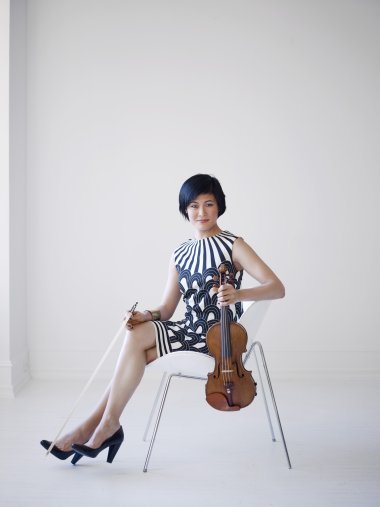
How did you choose this program at SF Performances?
Tania Léon's piece, Para, was a piece she wrote for me that we premiered last year. Having worked with her over the years, and in my discussions with her, there’s something that always feels very French [about her work], so I felt that was a natural pairing.
I was very close with Kaija Saariaho, who is Finnish but lived in Paris. I feel like there's an interesting relationship between her music and more traditional French music.
Then, I wanted to explore Lili Boulanger, because her pieces are beautiful and she and her sister, Nadia Boulanger, actually taught the great composers that we know today and I work with, like Philip Glass.
It felt like a natural link of these three very important and great artists that are contemporary.
I hadn't performed Fauré’s Sonata for many years. There's something so beautiful about it. Even in these dark and difficult days, I think there was a part of me that just wanted to play something beautiful.
Then the Ravel Sonata is a piece I've really felt close to for many, many, many years. I think it's the construction of it.
For this program, you’re collaborating with pianist Thomas Sauer who you frequently perform with. Why do you two work well together?
We come very much from the same kind of musical school of thought. He worked a lot with Felix. He went to the Marlboro Music Festival, and he also values contemporary music. It's nice to be able to find somebody that enjoys doing both things, and sharing those things, so it's a great partnership.
What do you like about coming to San Francisco?
My best friend has lived in San Francisco for many years. We've been friends since she was 13 and I was 11, so I feel very close to the city because I would visit so much just to see her. We spent so much time together here over the years.
I've had a very long relationship with San Francisco Performances, and I love their audiences. I appreciate them so much. I think SF Performances was one of the first series that engaged me for recitals, and I will never forget that because it was such a big influence in my life. So, I'm very grateful to San Francisco and to the series, and it's always very special for me when I'm able to come back to San Francisco Performances.