If you liked last year’s Bluebeard’s Castle at Opera San José — in which director Shawna Lucey came up with a satisfyingly feminist conclusion to the story — you’ll also like her production of Pietro Mascagni’s Cavalleria rusticana (Rustic chivalry) and Ruggero Leoncavallo’s Pagliacci (Clowns), seen on opening night at the California Theatre on Sunday, Feb. 15. She brings feminist analysis to bear on the two operas, which have been joined at the hip since the 1890s.
Her staging, originally created for Lyric Opera of Kansas City, makes explicit the male violence against women that’s implicit in the two operas, as well as other patriarchal attitudes. She sets the operas in the same Sicilian village, with Cavalleria set before World War I and Pagliacci set after it.
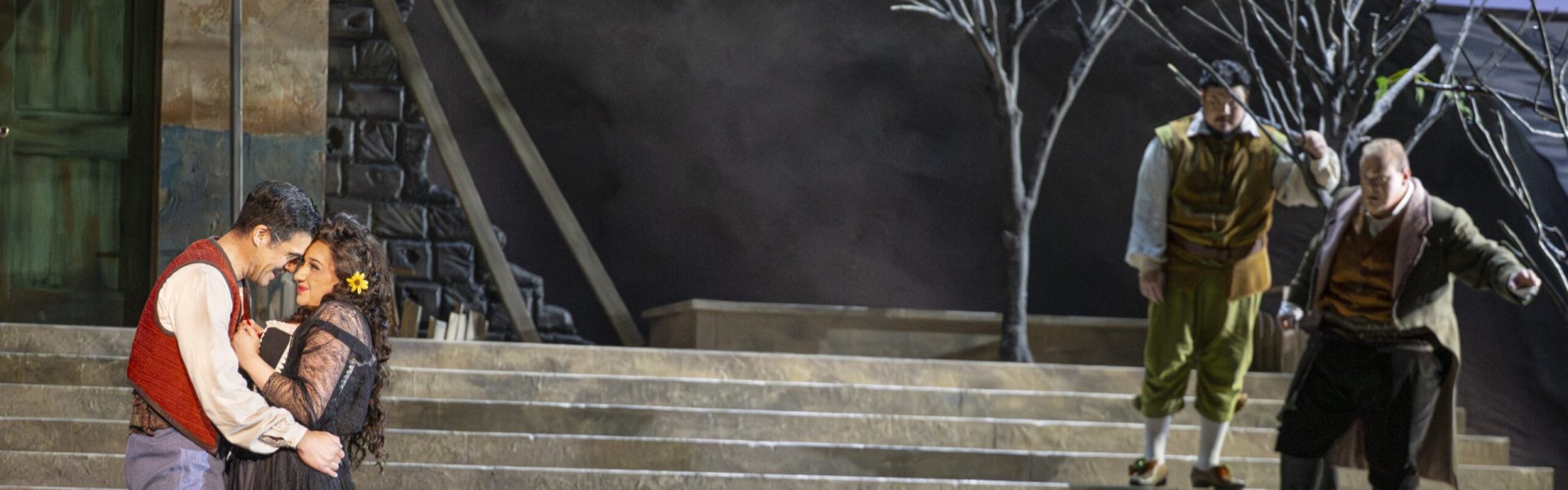
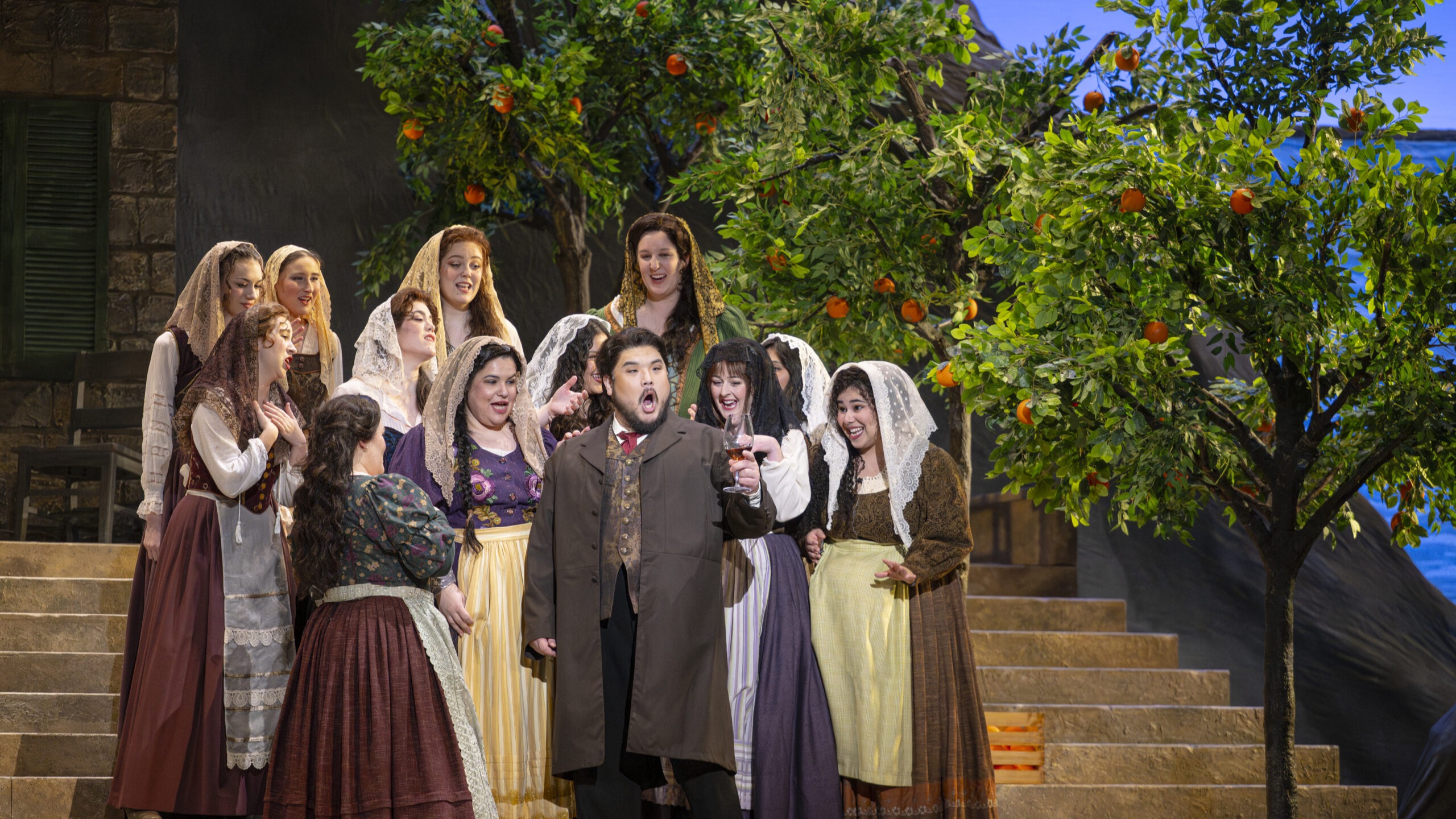
In Pagliacci, the ravages of the war are visible on the sets: damaged buildings, the boarded-up storefront of Trattoria di Lucia (Mamma Lucia’s restaurant in Cavalleria), posters for the Fascisti, the party that put Mussolini into power. Scenic designer Stephen C. Kemp’s unit set — a village square defined by a few buildings and many stairs, with a steep hillside and dwellings in the background — is both handsome and functional.
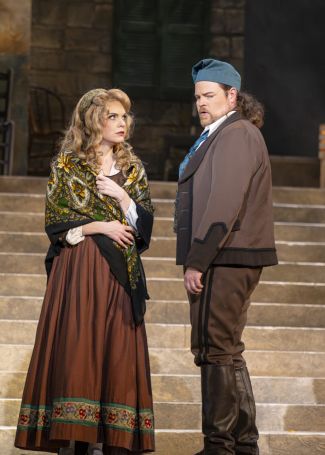
Both operas were well cast and strongly directed, but Pagliacci received the better and more nuanced performance, largely because Cavalleria was much too loud. That was a problem right from the start, with Turiddu’s serenade. ”O Lola!” is typically sung offstage, but while tenor Christopher Oglesby wasn’t visible from my seat, he might as well have been planted center stage. He has appeared with distinction in a number of recent Bay Area productions and is fully capable of the tenderness expected in this aria, but here he almost bellowed.
Alma Deutscher, who turns 21 later this week, has been studying conducting since she was 16, but she is still comparatively inexperienced. She seriously misjudged just how loud the orchestra was in Cavalleria, undermining the singers, who had to sing at high volume much of the time, robbing their performances of vocal subtlety. Perhaps she didn’t take into account the extent to which the sets reflected and amplified the singers’ voices.
I hope Deutscher will take the volume down a few notches for the rest of the performances, because she’s working with an excellent cast. Soprano Maria Natale, last heard locally in that Bluebeard, brings a big, brilliant voice — ideal for the verismo repertory — and excellent acting ability to Santuzza, with whom Turiddu has had an affair that leaves her pregnant. She made Santuzza’s desperation and love for Turiddu palpable and wholly believable (though she could have clutched her abdomen a bit less — we got the point right away).
Mezzo-soprano Courtney Miller, an Opera San José artist in residence, was a bewitching Lola, with whom Turiddu is currently having an affair, behind her husband’s back. Kidon Choi, as Lola’s husband Alfio, has a marvelously rich baritone, and went from genial to simmering with fury as the opera raced to its conclusion. The veteran mezzo Jill Grove was a sympathetic Mama Lucia, who doesn’t realize just how much trouble her son Turiddu is in.
Lucey’s direction gave the villagers a good deal of telling detail: a pair of white-clad teenage girls strolling together into church, a group of women happily surrounding a pregnant — evidently married — woman. They shun the outcast Santuzza for most of the opera, but then surround her protectively after Turiddu’s death. Something went wrong, though, in Turiddu’s scene with Mamma Lucia: the audience laughed at “Mamma! Mamma, quel vino è generoso” (Mamma, that wine is heady), a serious moment, when the half-drunk Turiddu knows he’s likely to die at Alfio’s hands.
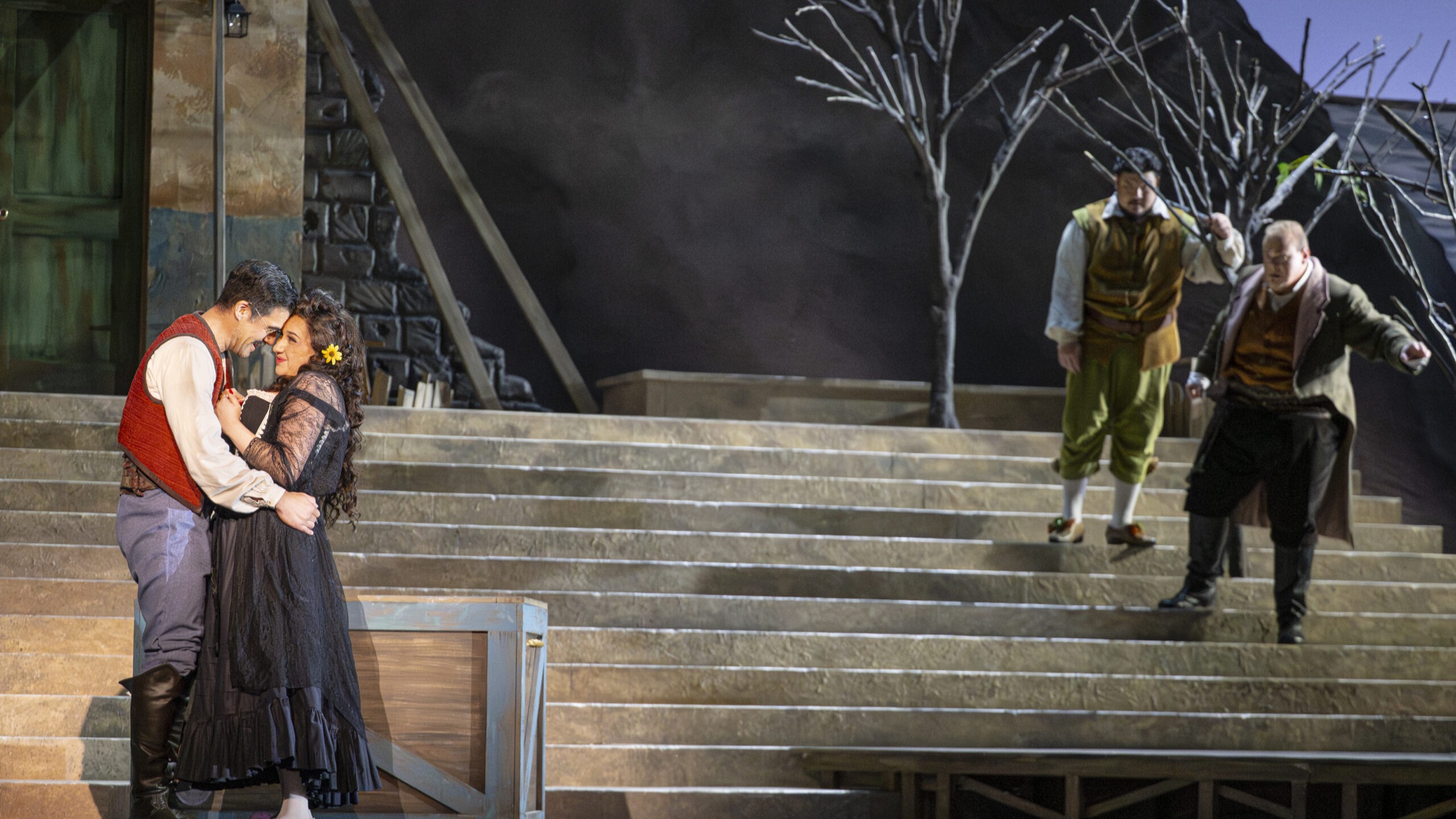
When the curtain goes up on Pagliacci, Canio (tenor Ben Gulley), leader of a commedia dell’arte theater troupe, is beating his wife, Nedda (soprano Mikayla Sager), in front of the stage where they’ll perform later in the opera. It’s in keeping with his character: He lives in the same patriarchal society as the characters in Cavalleria, after all.
Tonio (Kidon Choi in another strong performance) is in love with Nedda, who rejects him — and knees him where it hurts when he tries to rape her. She’s in love with villager Silvio (the sweet-voiced baritone Luis Alejandro Orozco), who treats her tenderly.
Tonio betrays the affair to Canio, bringing him to spy on Nedda and Silvio’s meeting. I wasn’t convinced that Nedda and Silvio were so enraptured with each other that they missed seeing Canio and Tonio lurking at the top of the stairs.
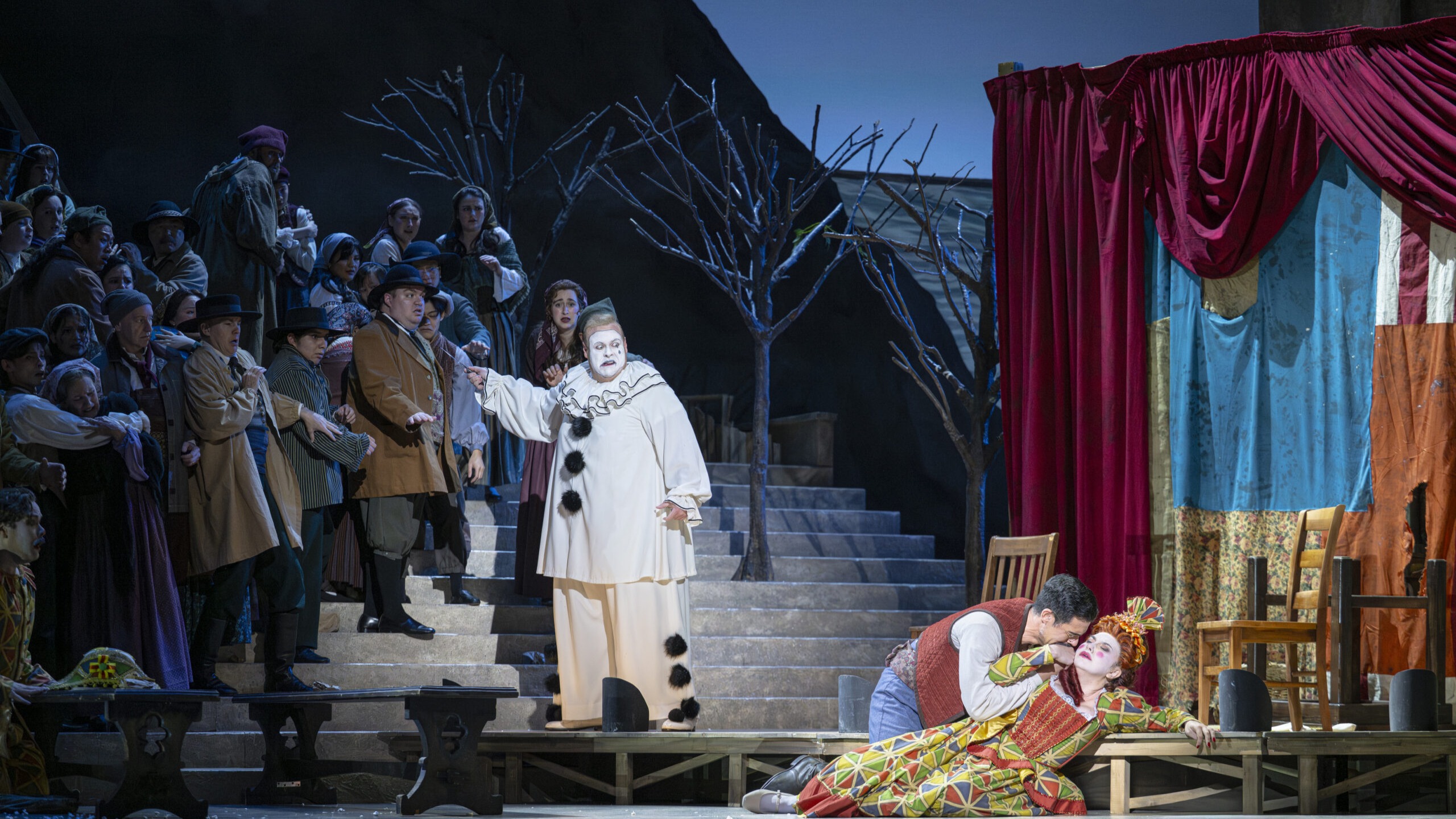
Gulley was a terrifying Canio, singing with vibrant power, his fury growing during the play-within-a-play that ends with the double murders. Sager’s dark, lyrical soprano and charming presence suited her character well; she was a delight in the song to the birds.
In Pagliacci, Deutscher kept the orchestra under much better control, and aptly distinguished the verismo body of the opera from the 18th-century musical pastiche of the play-within-the-opera. Four performances remain, on Feb. 20, 22, and 27, and March 1.