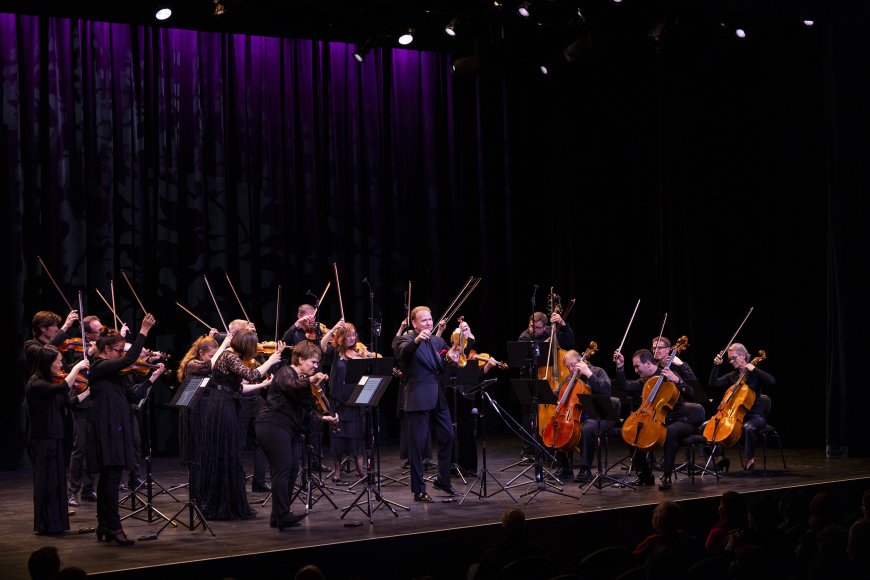
In “Luminaries,” the New Century Chamber Orchestra (NCCO) made an impassioned plea for music that doesn’t often get the spotlight. If the concept, or reason for the ensemble’s selections, was hazy, the Mar. 13 concert at First Congregational Church of Berkeley was nonetheless full of welcome surprises.
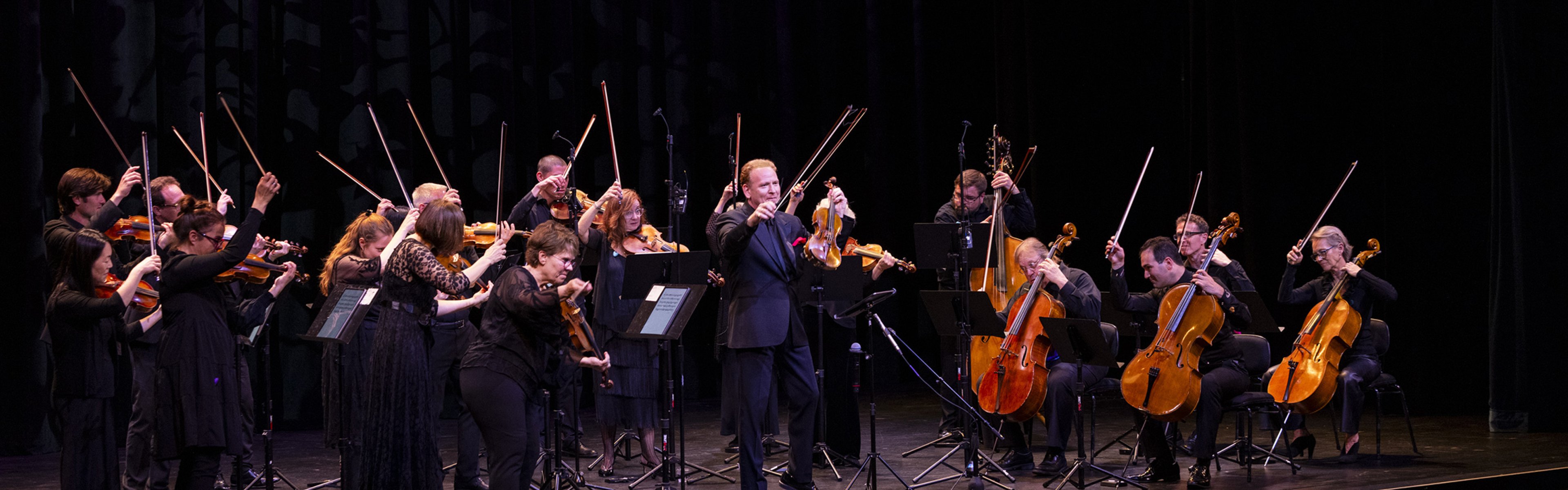
It is typical for chamber groups of four to six players not to have a conductor, but it is rare for a larger ensemble to go without one. Members of a chamber group gradually learn each other’s moves and come to function as a single body. Add twenty more members, though, and this undertaking becomes much more fraught.
This is NCCO’s impressive achievement: coordinating, among such a large ensemble, a wide range of expressive effects and registers — all without a conductor. Daniel Hope, the group’s director, concertmaster, and, in this program, soloist, is to be commended.
NCCO’s flexibility and power were most evident in the program’s heaviest hitter, Tchaikovsky’s Souvenir de Florence. Despite the title, the piece is no Italian capriccio, but instead a full-fledged four-movement symphony.
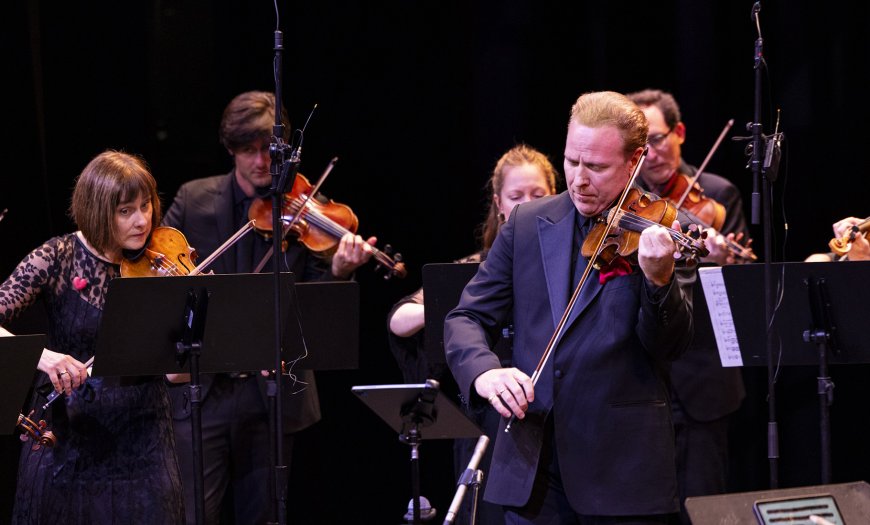
Originally composed for a sextet, Souvenir de Florence’s orchestral arrangement transforms its minor-key melancholy into an ominous emotional study. Even the lengthy pizzicato sections — which NCCO finessed with precision — can’t escape this brooding shadow. If this is Florence, it is Florence through the eyes of an implacable Russian. Tchaikovsky’s signature dancelike melodies give it away, especially in the third movement, which contains a galloping middle section that wouldn’t be out of place in The Nutcracker.
The other major piece on the program was the Violin Concerto in A major by Joseph Bologne, Chevalier de Saint-Georges. Stylistically, it couldn’t be further from the pathos of Souvenir de Florence. Whereas the latter is all sighing and twilight, the former is singing and sunlight.
The concerto is always just on the verge of letting loose. Like his Classical counterparts, Bologne teases starkly different moods in quick succession, though with his own idiosyncratic dose of coyness. Hope’s performance of this concerto — one of twelve the composer wrote for violin — is an obvious argument for Bologne’s rising profile these days.
Hope, as soloist, captured the characteristic charm of this music. His cadenza in the finale, including the cellist in a move that appeared to surprise the ensemble as well, was practically its own thrilling movement.
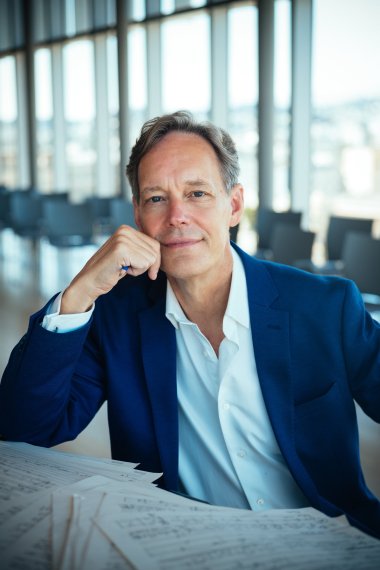
“Luminaries” also featured contemporary pieces by Jake Heggie and Nathaniel Stookey, commissioned by NCCO. While the works by Tchaikovsky and Bologne showcased the ensemble’s precision and power, these smaller pieces challenged the ensemble’s ability to inhabit a different musical logic.
Both contemporary pieces require an incisive, propulsive playing to draw out the expressiveness of the composers’ angular melodies. While the especially resonant hall worked against the musicians in this regard — their attacks in Heggie’s Overture were surprisingly muddy — the ensemble’s full-bodied playing largely pulled off its transformation. The buoyant, syncopated lines of both Heggie’s and Stookey’s pieces were their own world of sound.
By the end of the concert, I couldn’t help but think that there simply wasn’t enough room for this new music. Orchestras and composers likely imagine that they need to keep contemporary offerings short to make room for bigger fare and to avoid fatiguing listeners. “Luminaries” convinced me that the opposite is true.
Souvenir de Florence works because Tchaikovsky provides time for its melancholy world to evolve, for its clouds to pass; Bologne’s concerto is similar, as its middle movement gathers the energy for its explosive Rondeau. Heggie’s and Stookey’s pieces, on the contrary, are cut off before we can even get familiar with them. I especially felt robbed in regard to Stookey’s Bubble Chamber, a daring, impressively un-bubbly piece that deserved more time to fully untwist its diabolical strands.
It is not up to New Century to correct a trend long in the making. But if Hope and his ensemble continue to commission new pieces and program music from the canon’s peripheries, they will be making a huge contribution to the world of modern music.