Piano miniatures are easy to overlook, as they lack the space to produce what we love most about classical music. A larger piece creates its own world of characters and feelings, crafting a narrative that becomes part of our own inner lives. In the miniature, however, there is only enough time to outline a feeling or image before moving on. The genre’s brevity makes miniatures ideal for pedagogical exercises and children’s albums (think Béla Bartók’s Mikrokosmos or Tchaikovsky’s Album for the Young).
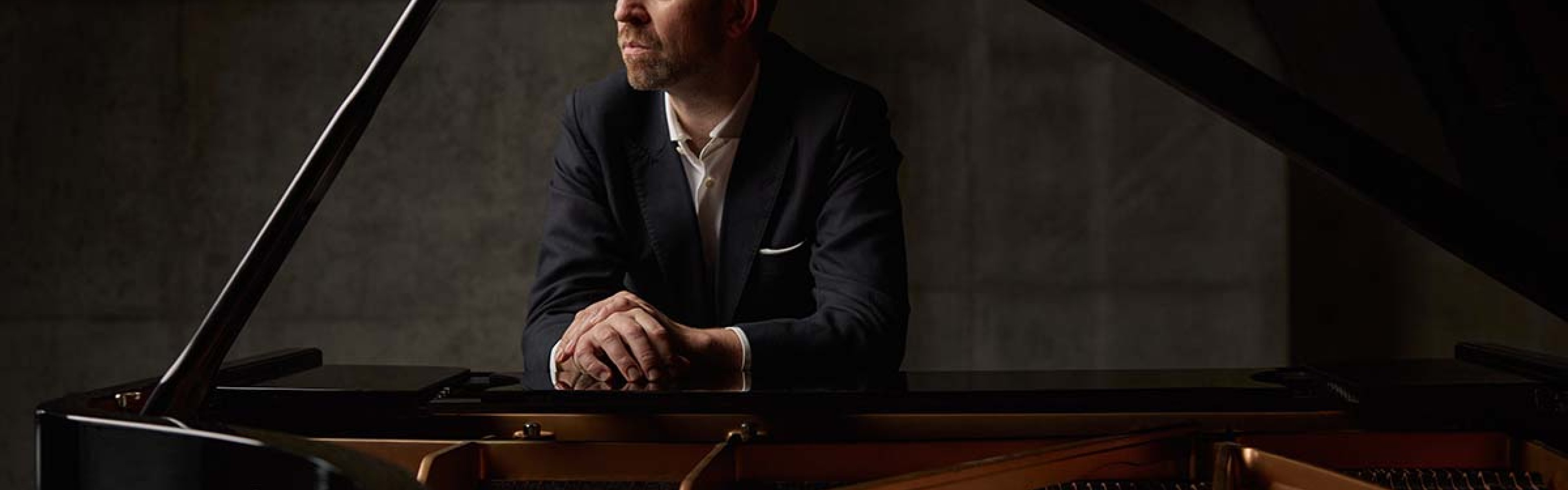
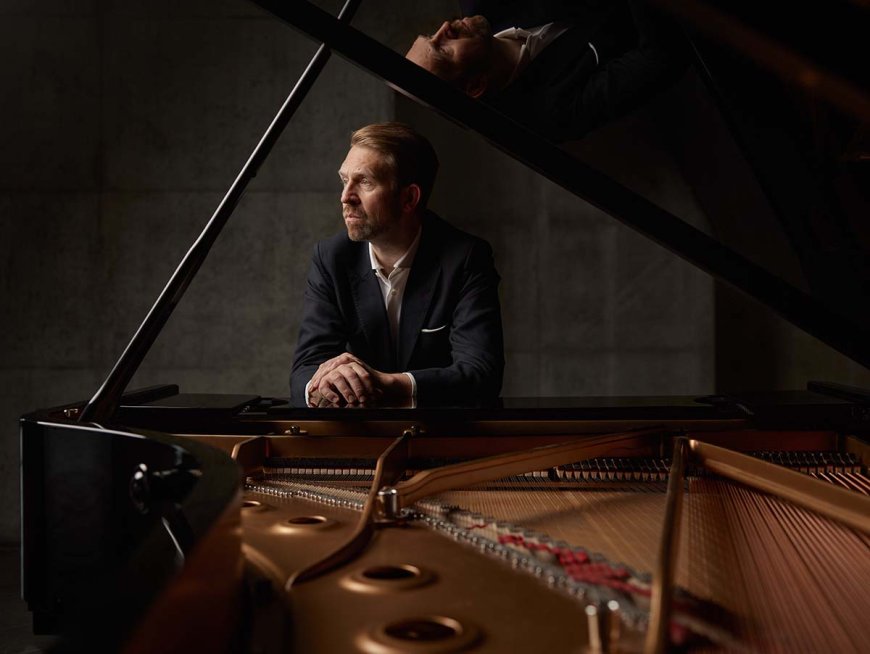
But, as Leif Ove Andsnes’s Jan. 25 recital at Stanford Live proved, miniatures are capable of much more, paradoxically scaling the heights of expression and offering lessons for musicians and listeners alike. The program, spanning opposite ends of the twentieth century, contained sets of miniatures by György Kurtág, Leoš Janáček, and Robert Schumann each offering Andsnes the chance to flex his expressive power in different ways.
Kurtág’s Játékok is a large series of piano miniatures that the composer continues to expand today. Dating back to 1973, they are fragmentary, allusive pieces with titles drawn from Kurtág’s life, collectively functioning as a musical journal of the composer and his world.
Sunday’s set opened with “Doina Hommage à Farkas Ferenc (evocation of Petrushka),” an ode to Kurtág’s former composition teacher. The work captures a breadth of reference, drawing on eastern European folk music and Igot Stravinsky’s modernist ballets. Andsnes did not play into the contrast between its two gestures — a declamatory, monophonic melody and a sixteenth-note run of thirds — but connected them. In Andsnes’s hands, this was no playful evocation of a schoolteacher, but a powerful, even ominous figure surrounded by storm clouds.

Andsnes extended this darker interpretation to a pair of pieces that, albeit out of sequence, synthesized in a powerful scene. “Les Adieux (in Janaček Manier)” is comprised of mournful gestures that culminate in a repeating bass ostinato. The pianist gradually increased the intensity of this note to build to the next piece, “Sirens of the Deluge — Waiting for Noah,” a medley of broken phrases that morph into a repeating, rhythmic cell.
Putting the two side by side, Andsnes cultivated his own trajectory, in which the melancholy feeling of “Les Adieux” evolved into the manic, mechanical pounding of “Sirens of the Deluge.” He thus paid attention to something more interesting than the music’s biographical references; he made it mean something to us.
If Andsnes employed a heavy hand in interpreting the terse scenes of Játékok, he used a lighter, more songlike approach to the first series of Janáček’s On the Overgrown Path — a set of ten pieces that echo Moravian folk music. The composer himself described the series as “distant reminiscences” of both his childhood and the death of his daughter at only 20 years old. This explains the melancholy and ambivalent tone of this music, ranging from the nostalgic “Our Evenings” to the ruminative “Unutterable Anguish.”
Andsnes played these pieces lyrically. This was most apparent in “The Madonna of Frydek.” If the pianist’s left hand occasionally seemed too loud or insistent, here the balance was perfect. Andsnes played the trill-like accompaniment with impressive precision, so that the voice of the Madonna seemed to float above it. The contrasting chorale was bright, strong, and louder than anything else on the program, for a moment hinting at the joy tucked within these reminiscences.
The pianist breezed through these sets without pause, immersing us in a flow of images and feelings. While a sonata or symphony might create a coherent narrative, these miniatures instead concentrated on the ephemeral, inviting us to open up to unexpected feelings and connections. Schumann’s Carnaval similarly offered a riot of characters — as well as a welcome demonstration of Andsnes’s technical finesse — but it could only pale in comparison to what Kurtág and Janáček offered: a nuanced, expressive imitation of life.