The Dialogue of Memories, a new opera by composer Tom Cipullo and a libretto by Howard Reich and Cipullo, marks the 50th world premiere hosted by the Seattle-based Music of Remembrance. The performing arts group was founded in 1998 with a focus on Holocaust remembrance. Today, it advocates more broadly for human rights and social justice.
While the very fact of this opera’s existence is a testament to MOR’s impressive commitment to new works, The Dialogue of Memories is more cardboard than flesh and blood. Though the work has the bones of a successful opera — compelling music and great performances by the pit and cast — its opaque libretto holds its feelings and lessons at a distance.
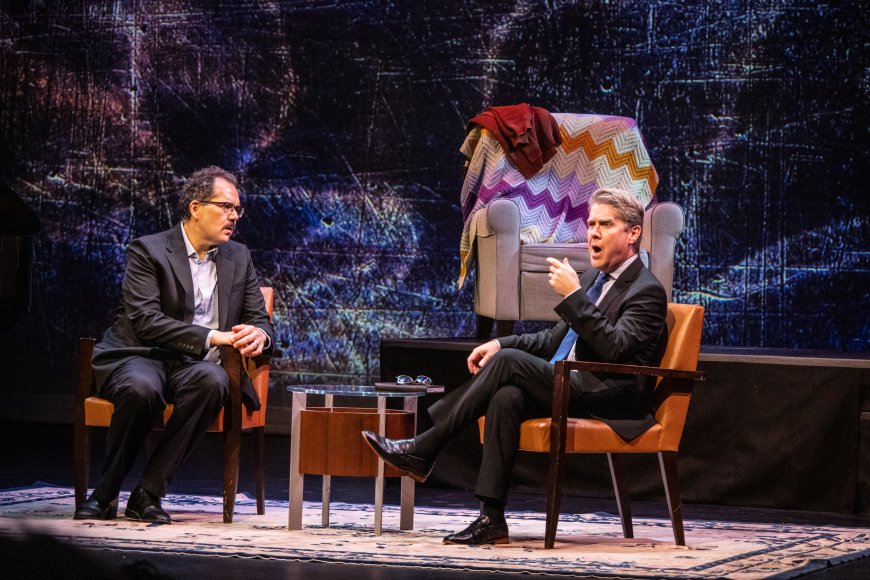
The Dialogue of Memories is a brisk, 50-minute three-hander. The opera is an adaptation of Howard Reich’s 2019 book, The Art of Inventing Hope: Intimate Conversations with Elie Wiesel. The book’s central theme is also the opera’s: how the real-life friendship between Reich and Wiesel — famous writer, Nobel laureate, and Holocaust survivor — nurtured lessons about family, memory, and the pain and power of the past. The opera condenses four years of friendship into a set of loosely connected scenes, in which Wiesel (played by baritone Daniel Belcher) helps Reich (tenor Dominic Armstrong) discover and grapple with his mother’s past as a Holocaust survivor.
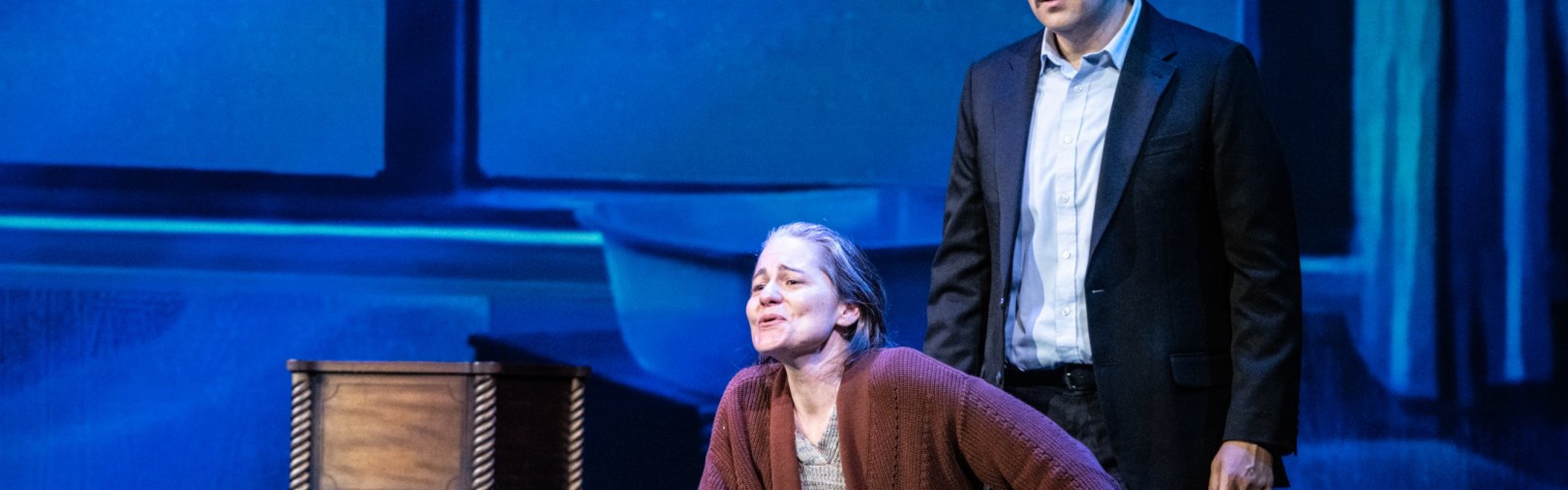
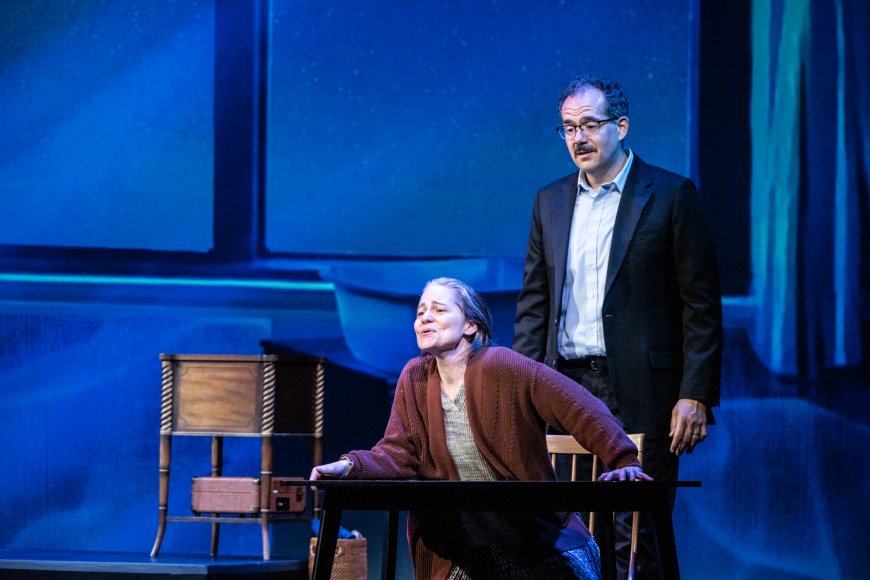
Mezzo-soprano Megan Marino as Sonia Reich, Howard’s mother, is the heart of the opera. Sonia is given very little space to perform, and yet her presence infuses every scene. (Director Erich Parce and media designer Peter Crompton make the most of the small stage through platforms, atmospheric projections, and naturalistic blocking, directly translating the opera’s intimacy.) The opera pivots on Howard’s perspective and his struggle to see through his mother’s stoicism, but it unfolds most compellingly when Sonia sings.
The composer gifts her music that ranges from giddy and bouncing to devastatingly spare, and Marino made the most of it. In an alternately powerful and reserved climactic aria, arguably the opera’s centerpiece, Sonia begs her son: “Tell your children… I remain human.” This contrasts with her earlier entreaty, set against an ominous string ostinato, to “never tell anyone you’re Jewish.” The gulf between these moments is the opera’s revelation. Sonia is both proud and ashamed, hopeful and despairing, brave and fearful. Through his discovery of her past, Howard comes to understand the tragedy that continues to feed this duality, accepting his mother in all her complexity, fear, and love.
Wiesel, sitting downstage this entire time, is the key to Howard’s growth and discovery. But while Wiesel ostensibly constitutes the opera’s moral core, he is more a cipher than a living character. His occasional arias, in which he offers Howard compact pieces of wisdom, are affecting but dramatically unconnected to what’s going on and, even worse, cliché. There is so little direct interaction — and so much talk of ghosts — that I wondered if Wiesel was a vision, Howard’s private memory, or an interpretive tool for the audience.
It is also unclear if Howard is actually interacting with his mother, or if this might also be a memory or a projection. This practical fuzziness robs the story of its power, as the stakes of these interactions are unclear. As it is, Wiesel is an awkward observer most of the time, and Howard’s relationship with his mother provokes more logistical questions than emotion.
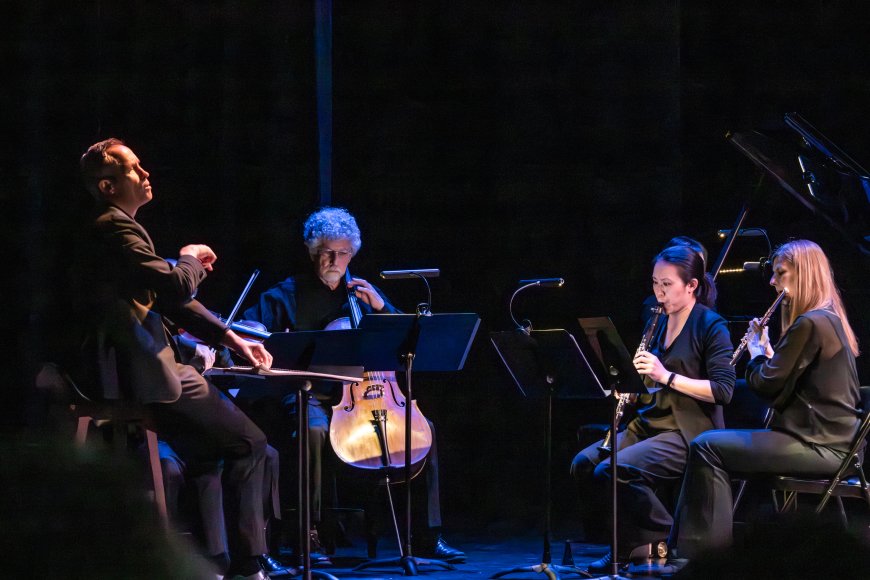
Cipullo’s score mostly redeems this dramatic slackness. The combination of flute, clarinet, violin, cello, and piano, under conductor Alastair Willis, swells with color and textures not typical in opera but compelling here. Unlike the music of many new operas, Cipullo doesn’t shy away from formal divisions — there are arias, duets, and trios. Each aria is built on a repeating single lyric or line, often with a da capo-like interlude or episode. These mini musical arcs are the best part of the opera, offering coherent mini dramas that illuminate the characters and give the singers something to bite into.
One such aria is Sonia’s reflection on running the family bakery in Chicago. The music is eager and comical before suddenly giving way to a quiet, fearful reserve. In just a few minutes, the aria captures the complicated, messy joy at the root of the family’s life.
The episode is a much-needed change of pace for the opera, which otherwise proceeds mostly at an andante. Cipullo’s idiom is wonderfully lyrical, elevating and clarifying the singing, but this mood sometimes flattened the multidimensional interactions of the characters. When the opera at one point suddenly broke into a flashier, jazzy style, complete with a Gershwin quotation, it revealed how much more colorful the opera might have been.
The opera ends with Wiesel’s wordy advice: “Let your surplus be a healing for the world.” In such a meditative, lyrical finale, could there be a worse word than “surplus” for a performer to have to sing? This jarring mismatch of words and music encapsulates the problem of The Dialogue of Memories. The prose-like text of the libretto and the wandering plot foreclose what opera is so good at: adding layers of feeling to seemingly simple facts, stretching moments to epic proportions, and illuminating perspectives that otherwise go unnoticed. The Dialogue of Memories gets close to this at points, but its didactic center gets in the way.