Now in its 16th season, Pacific Opera Project has never played it safe.
Under the imaginative and iconoclastic leadership of its founding artistic director Josh Shaw, POP has staged over 60 acclaimed productions, often of little-known works by famous composers.
For its latest offering, a historic, spirited, and colorful American premiere of Gaetano Donizetti’s backstage Neapolitan comedy, Il fortunato inganno (The Happy Deception), POP has set up camp at the Garibaldina Society in Highland Park for six performances that run through Sept. 13.
POP presented the show as a dinner-opera, with seating at round tables. Patrons were served a plate of pasta and a glass of wine to get them in a proper Italian mood.
Il fortunato inganno originally ran for three performances in Naples in 1823 and then disappeared for 175 years. Shaw managed to track down the score in Italy, where the Festival della Valle d’Itria had staged a 1998 revival. To make it suitable for an American audience in 2026, he trimmed most of the spoken dialogue and reduced the orchestration to an ensemble of 11 players, here conducted with conscientious energy by Alexandra Enyart.
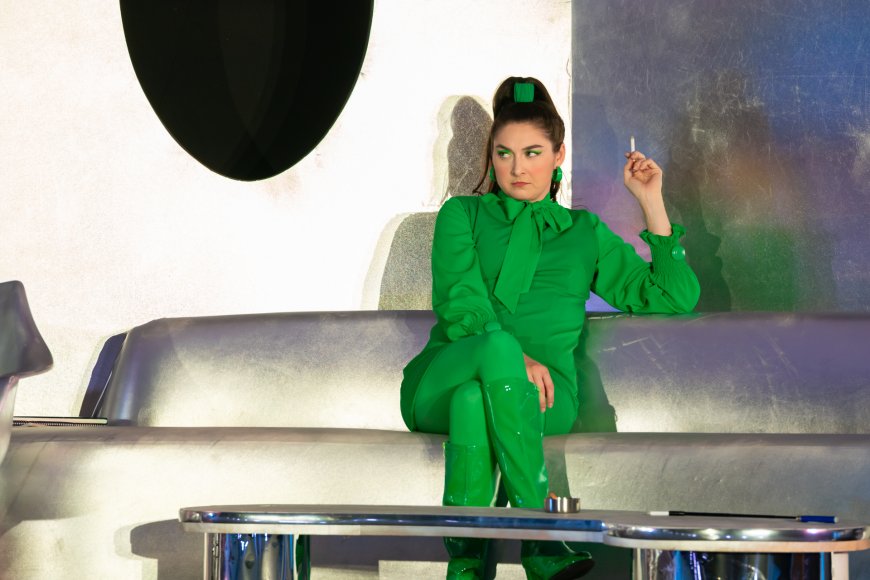
Why Il fortunato inganno flopped has been blamed on the admittedly silly libretto by Andrea Leone Tottola. The flimsy plot — padded by numerous and tedious digressions — turns on the 18th-century idea that opera performers are people of ill-repute, and unsuitable for respectable marriages.
As the story goes, Aurelia (sung by a game and vocally agile Avery Boettcher) is a prima donna and wife to the primo buffo and impresario Lattanzio Lattughelli (sung by E. Scott Levin, veteran of 32 POP productions). Aurelia is determined that her niece, a singer, should be married to the nephew (here, sweet-voiced tenor Fran Daniel Laucerica in his POP debut), of an upright Colonel (the very tall and vocally stiff Kenneth Stavert).
Aurelia pretends to fall in love with the Colonel to achieve this goal, realized in the end during one of the splendid accelerating ensemble finales (“Il Mortal più beato”) for which Donizetti became famous. In the spectacular aria “La tenzon io non ricuso,” Boettcher delivered with aplomb and bell-like clarity a series of high D’s and thrilling cascading bel canto roulades.
The production required all the performers to master singing and speaking in rapid-fire Italian, and even occasionally in tricky Neapolitan dialect, a considerable feat they executed with apparent ease.
POP has staged productions in a variety of unlikely venues around the Los Angeles area: churches, warehouses, social clubs — even a drive-in parking lot for COVID fan tutte, its resourceful pandemic adaptation of Mozart’s Così fan tutte.
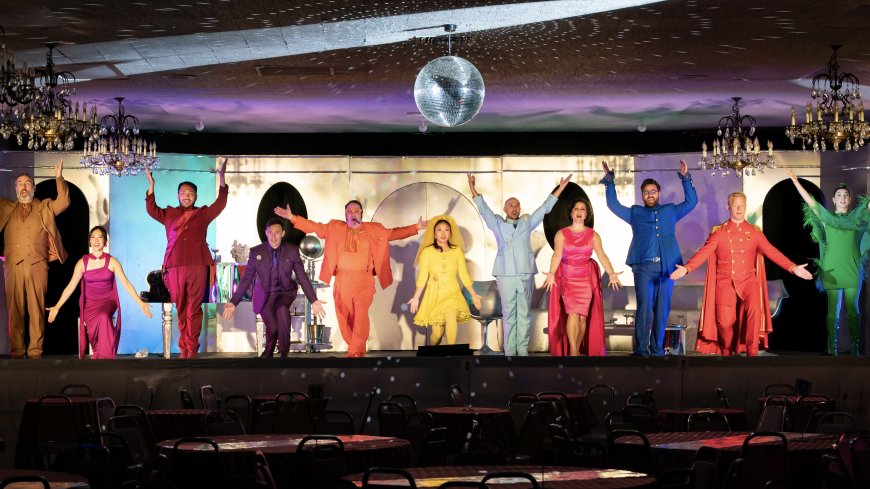
As a setting for opera, the Garibaldina presented some challenges for this staging of Il fortunato inganno. The shallow and short improvised stage restricted the physical movement of the eleven cast members. The orchestra’s placement on the floor off to the side made it difficult for the singers to coordinate with the orchestra. The low ceiling covered with acoustical tiles absorbed the sound and threatened to graze the singers’ heads.
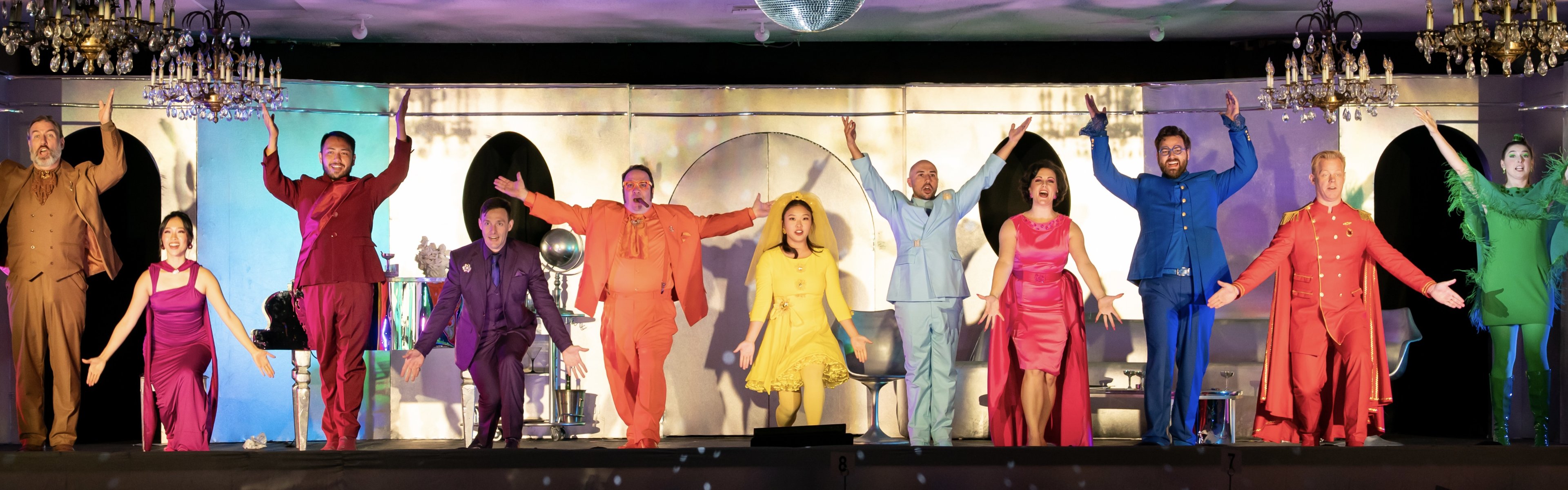
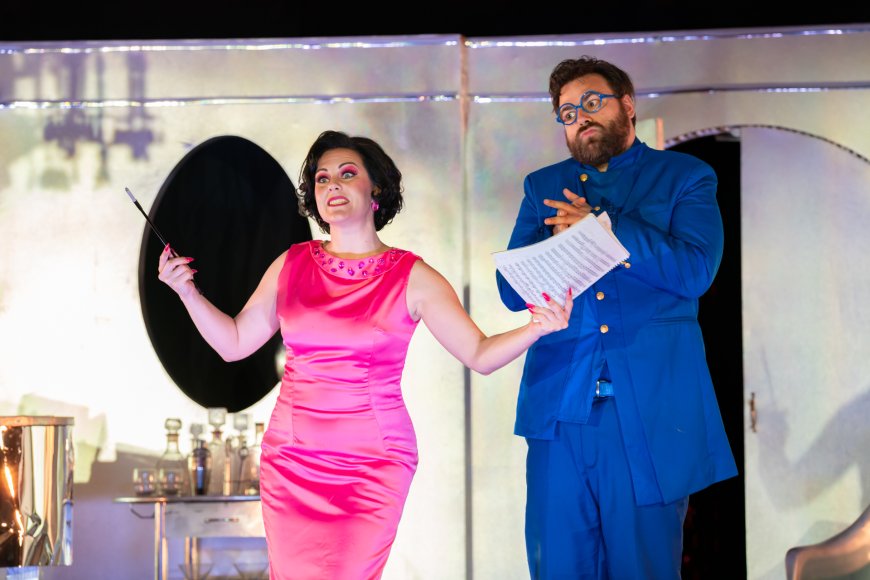
But Shaw and his well-trained cast managed to overcome these obstacles. Updated to the swinging 1960s, the action unfolded against a shiny silver-colored backdrop. A silver Liberace-style grand piano served as the site for numerous gags. Disco strobe lights flashed at irregular intervals. Modish swivel chairs provided dynamic motion and a dizziness suiting the madcap narrative.
Costuming the singers in bright primary colors made it easier to recognize who was who. The choreography consisted mainly of side-stepping chorus lines and heads bobbing to the beat.
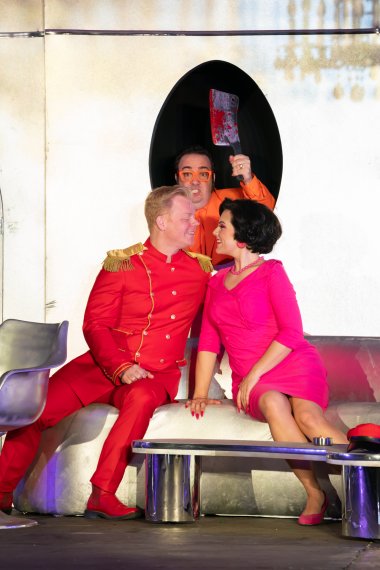
When Donizetti wrote the score at only 25 years old at the time, he was still finding his voice. Repetitive major-to-minor modulations and rhythmic patterns dominate. The vocal cat fight (“lo tel dissi, l'assicuro”) between the divas — mezzo Fulgenzia del Foletto (Kira Dills-DeSurra) and Aurelia — who compete for preferential treatment from the composer Bequardo (robust baritone Joel Balzun) was a treat.
At a little more than two hours, the two acts of Il fortunato inganno felt at times over-long, and could have benefitted from more judicious pruning. But kudos to POP for introducing this work of Donizetti’s youth to an American audience for the first (and very possibly last) time, giving us the opportunity to see the early evolution of one of the greatest masters of opera.