For 20 years, Beth Morrison Projects has provided an incubator for composers, lyricists, directors, and designers to create intimately scaled, innovative operas and boundary-stretching musical experiences.
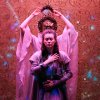
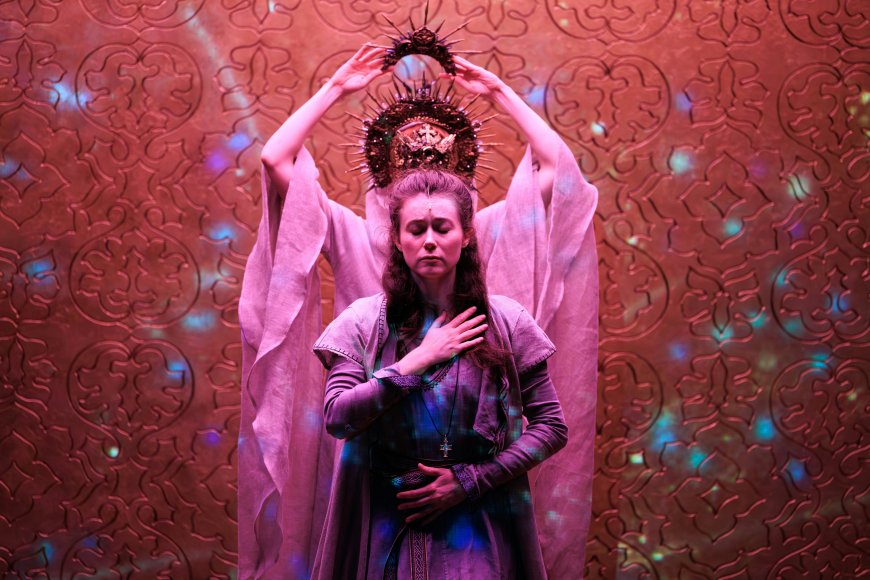
BMP’s latest offering is Hildegard, an opera inspired by the life of the 12th-century Benedictine abbess, Hildegard von Bingen. Composed by Sarah Kirkland Snider (who also wrote the libretto) and directed by Elkhanah Pulitzer, Hildegard had its world premiere last November at the Wallis Annenberg Center for the Performing Arts in Beverly Hills, in a co-production with Los Angeles Opera’s “Off Grand” series. The East Coast premiere takes place at John Jay College’s Gerald W. Lynch Theater Jan. 9–11 and 14 as part of the company’s annual Prototype Festival.
Morrison, who is always scouting talent, began the process by telling Snider, “I think you’ve got an opera in you.” After considering a wide variety of source material, the composer focused on Hildegard, whose career and music experienced a revival of interest in the 1980s.
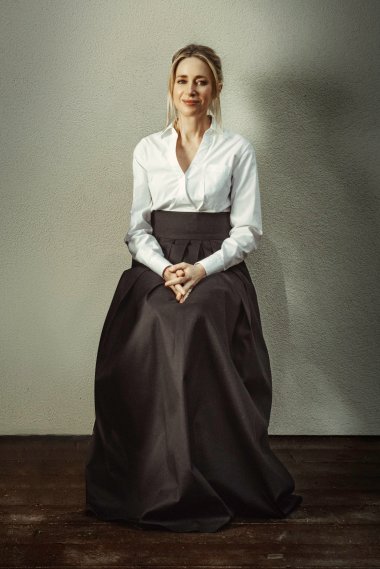
“We all knew it was going to be a daunting task to create an opera based on a woman that lived in such a different time with so many dimensions to her life,” said Snider. And as her research took her deeper and deeper and deeper into Hildegard’s world, she began to feel like Alice down the rabbit hole.
Hildegard was born (approximately) in the year 1098 and died Sept. 17, 1179. She lived almost her entire life in monastic seclusion — as a nun, abbess, and eventually founder of two monasteries. A true polymath, she wrote works on theology, natural science, and medicine, as well as the morality play Ordo virtutum. A biography of her life was later compiled as the Vita Sanctae Hildegardis. She was also a prolific poet and a composer of sacred chant, much of it inspired by her visions.
“Initially, I felt responsible to her legacy,” Snider recalls. “While we’ve come to know Hildegard’s music, her accomplishments in philosophy and religion are not nearly as well known as they should be. If Hildegard had been a man, she would be as well-known as Thomas Aquinas.
“When I would tell Beth and Elkhanah all the things I thought had to be included, they would say, ‘Sarah, this is an opera, not a dissertation! You need to find the operatic story in her story, the themes that have emotional resonance today.’”
The opera’s first workshop five years ago, Snider recalls, was not a success.
“I’d composed 50 minutes of music, and it didn’t work at all,” she says, laughing. “I don’t think anything from that first workshop ended up in the final version.” So she and her collaborators began to chisel the material into the story they ultimately told.
Shaving the time frame to one year of Hildegard’s life, the opera now focuses on her conflict with the priesthood to gain papal recognition of her visions, the love relationship she developed for the young novice Richardis von Stade, and the mysterious, overwhelming experience of the visions themselves.
“Ultimately,” says Pulitzer, “it was Hildegard’s visions that provided the turning point. They allowed us to step outside the real world of the convent and introduce a totally different reality.”
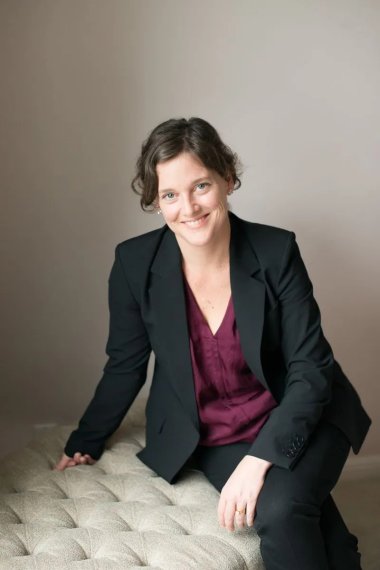
But Morrison points out that Hildegard’s visions also presented a challenge: as the abbess wrote them, they were entirely rooted in medieval Christianity and its understanding of self. As Morrison put it, “We felt Hildegard’s experiences and visions needed to feel relevant to today’s wider audiences.”
Ultimately, inventing a personification of the visions provided the answer. Snider said the idea came to her one night while walking her dogs
“I imagined this faceless woman who appears as a recurring vision to Hildegard,” the composer said. “She could represent Hildegard’s unacknowledged self, vis-à-vis her sexuality, her feelings for Richardis. It provided a way for us to explore themes through her visions that were not just about religion.”
The Faceless Woman, who Pulitzer cast as a dancer, became the opera’s bridge between the medieval monastic Christian world and today’s world.
Having taken the first step outside the history book, Snider then went on to write her own libretto, including Hildegard-inspired chant.
To create a compositional demarcation between 12th-century monasticism, the contemporary nature of the dramatic conflicts, and the transcendent realm of Hildegard’s visions, Snider developed a tripartite musical vocabulary.
“When we are in the realm of the convent,” she explained, “the vocal music is inspired directly by the antiphons Hildegard composed for the liturgy. When the dramatic themes are distinctly modern, the music is contemporary, while the ethereal world of the visions takes on a completely different coloration.” Bolstering this idea, the composer scored the piece with a central role for the harp. “It’s almost a harp concerto,” she said with a laugh. “And the harp is stereotypically associated with the feminine.”
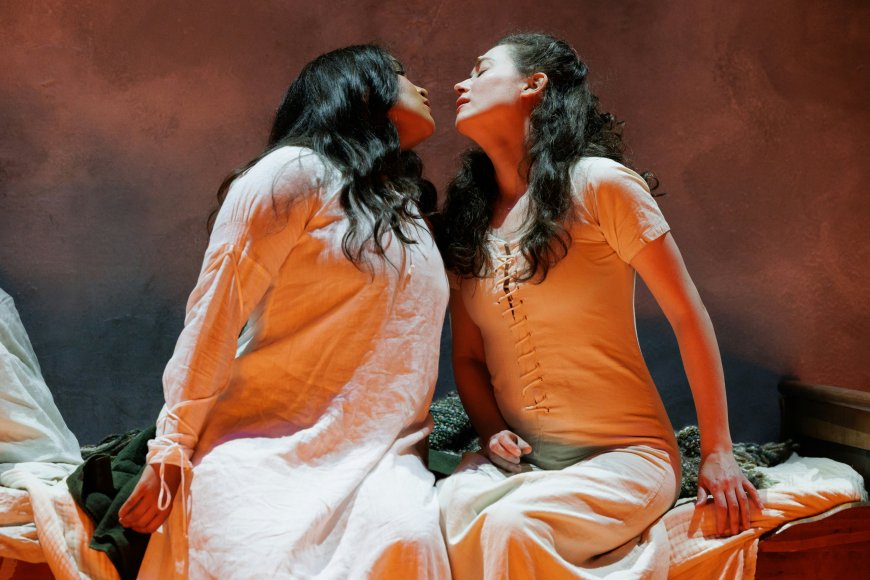
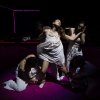
Economy of scale has always been an important part of BMP’s production process. This allows Morrison to mount experimental works in all kinds of musical styles, as a glance at this year’s Prototype Festival lineup shows. The scope of Hildegard, however, is still quite large and has all the impact of a full-scale opera production. In addition to the Faceless Woman, Pulitzer added dancers representing a group of fantastical medieval creatures who could have stepped out of a painting by Hieronymus Bosch. Elaborate projections help to represent Hildegard’s visions. Like the abbess herself, the opera seeks to transcend limitations with imagination.