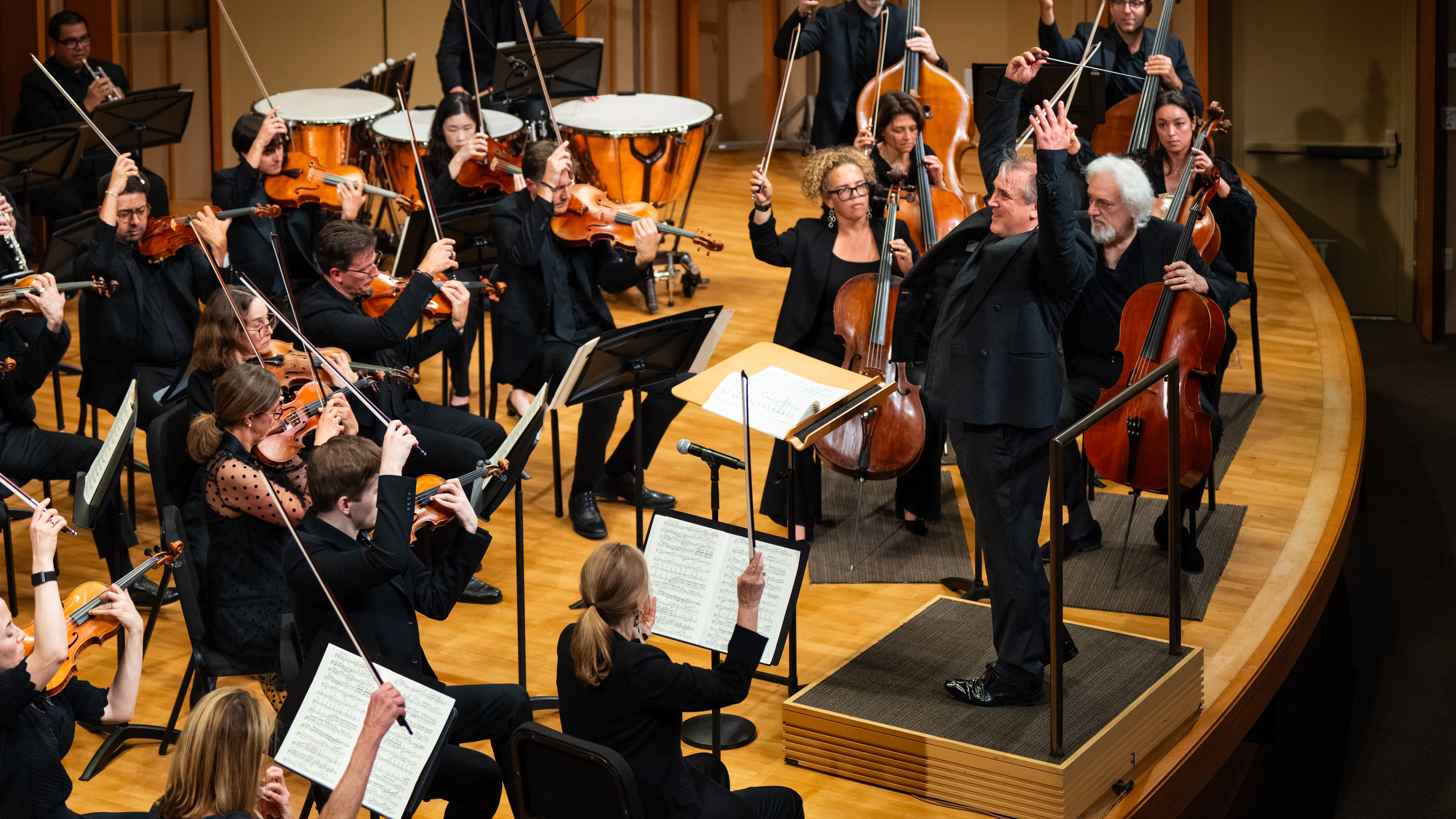
Many Los Angeles-based musicians and composers had their lives upended by the fires that ravaged Pacific Palisades and Altadena in January 2025. So, it was entirely appropriate that the idea of fire fueled the rich, moving, and healing program — titled “Temporal Echoes” — of new and old music that the Los Angeles Chamber Orchestra presented at Colburn Conservatory’s Zipper Hall on April 11. LACO’s ebullient music director Jaime Martin presided at the podium.
Two works responded directly to the historic conflagration. Composer Juhi Bansal, who lost everything in the Eaton fire in Altadena, was present to oversee the world premiere of her sizzling percussion-rich Fire Cycle. Eric Whitacre, a longtime L.A. resident and highly successful composer, commemorated the disaster with his anthem-like The Pacific Has No Memory, for violin and strings, in its West Coast premiere.
Whitacre wrote the solo part for the evening’s featured performer, violinist Anne Akiko Meyers. Her family is still displaced from the Pacific Palisades fires.
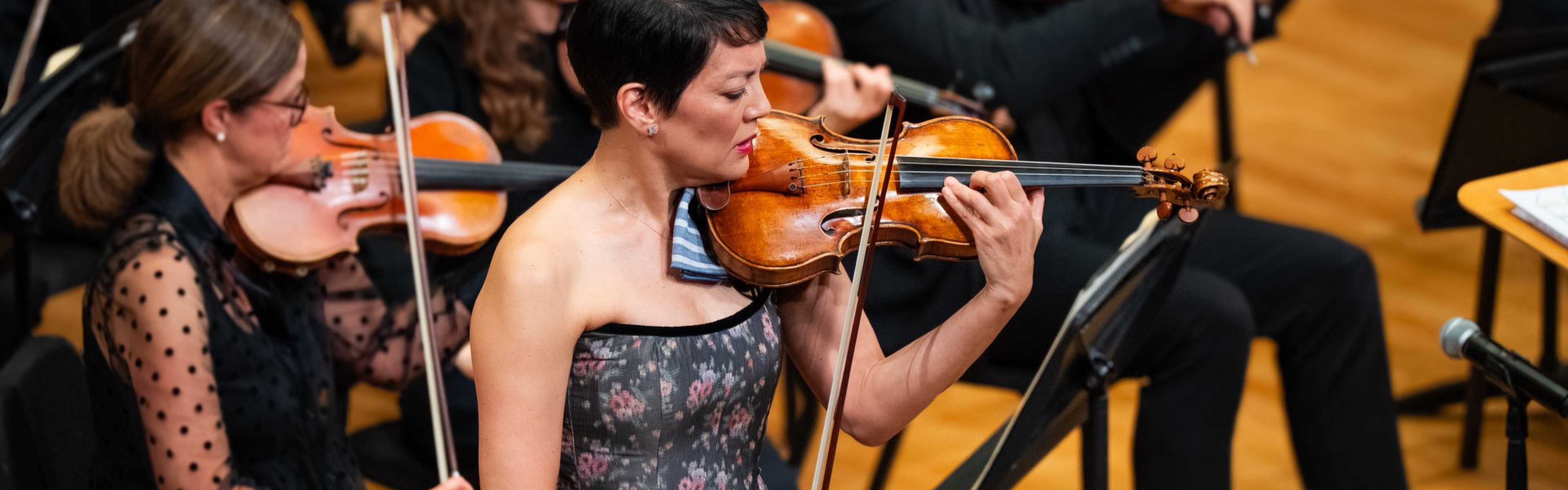
A Southern California native, Meyers spoke eloquently from the stage of her chaotic post-fire life of moving between hotels “with a family and a crazy dog and my violin.” Her polished, refined, and intonationally pure playing was the highlight of the evening.
Inspired by an image of the Pacific as a source of endless renewal from his favorite film, The Shawshank Redemption, Whitacre’s work gives the violin a keening melody that rises and falls like the waves. Gramophone praised the “glowing steadiness” of Meyers’s performance on a recording of the piece she made recently with the Orpheus Chamber Orchestra, which gave the world premiere at Carnegie Hall last spring. The piece appears destined to become a lasting memorial to L.A.’s recovery.
Known for her ability to fuse many different traditions and genres, Juhi Bansal has written numerous works inspired by ecological forces. Ironically, LACO commissioned her to write a work about fire several years before the catastrophic events in Altadena. Like Whitacre, she views fire as an essential part of the natural landscape, both destructive and renewing.
Structured in three parts moving from fragile normalcy to violent intensity to scarred return, Fire Cycle riffs on “jamming with the idea of fire.” Relying heavily on sliding muted string effects and sudden explosions from the harp, it calls upon the sole percussionist (Wade Culbreath, who gave a tour-de-force performance) to manage a wide range of instruments including a barrel, marimba, timpani, and gong to represent the crackling and hissing of flames. First violinist Margaret Batjer provided a gentle background of repeating arpeggios.
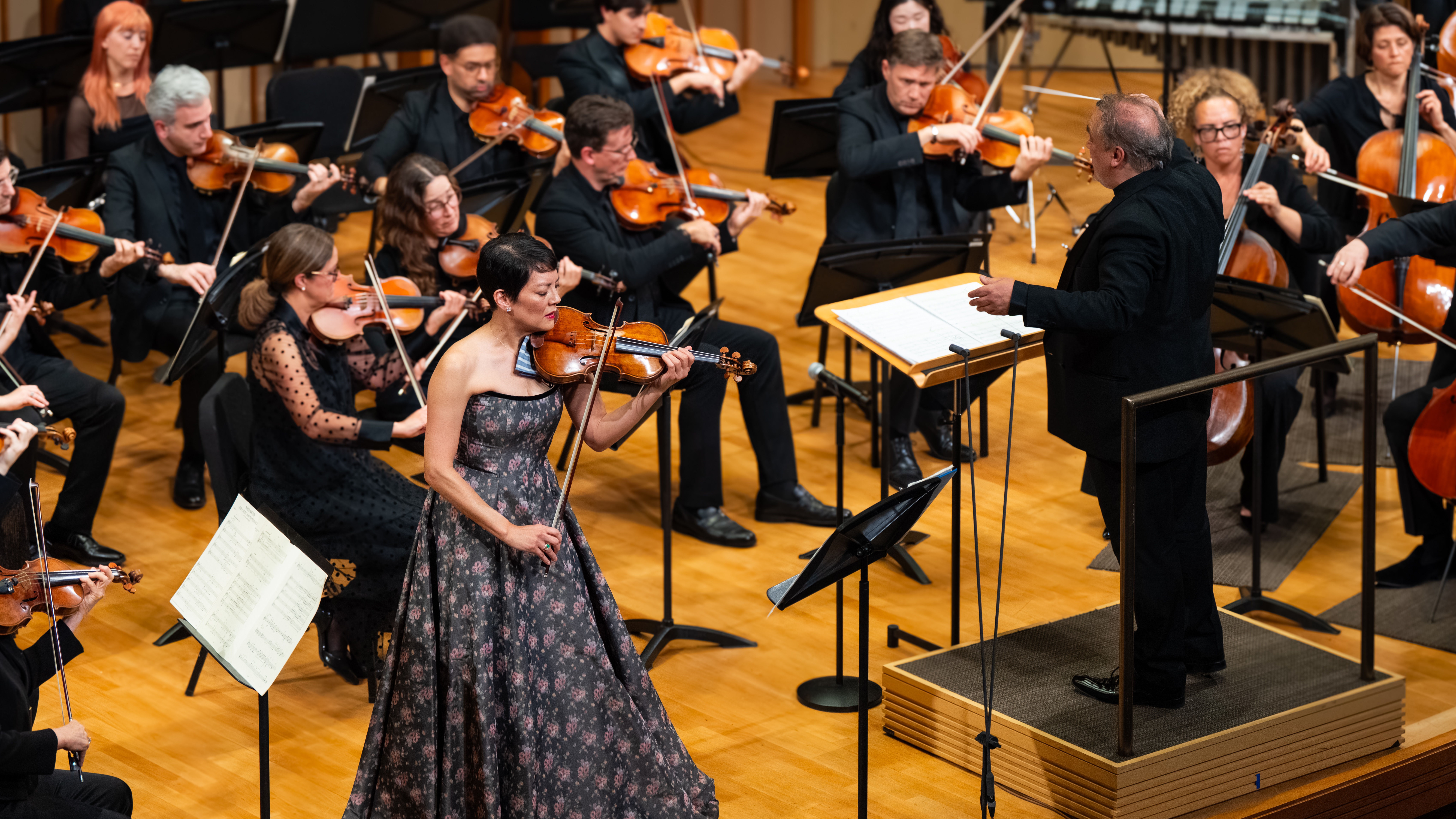
Ralph Vaughan Williams’ soothing and soaring The Lark Ascending came between the two new works in the first half. Here, Meyers’s bowing technique — which she made look so easy — produced a flowing, liquid tone, a seamless stream of sound that along with her pitch-perfect fingering held the audience spellbound.
After intermission came another work inspired by fire: Dmitri Shostakovich’s Chamber Symphony, Op. 110a. Shostakovich wrote this intensely personal confession of existential despair (an orchestral version of his String Quartet No. 8) after visiting the German city of Dresden, which was obliterated to ashes by Allied fire-bombing at the end of World War II and was still in ruins in 1960.
Shostakovich transforms his famed musical signature motif (D-E-flat-C-B) into a despondent lament, a frenzied Jewish dance, a sarcastic waltz, and finally a requiem. LACO gave a creditable and committed performance, but the strings lacked heft and intensity at crucial points.
Lest the evening descend into darkest depression, Sergei Prokofiev’s bubbly and optimistic Classical Symphony lifted our spirits. The composer wrote the work just as the Russian Revolution was shattering the sheltered world he had grown up in. A fond look backward to the age of Haydn and Mozart, he updated their familiar gestures with an irreverent modern sensitivity, employing awkward leaps and exaggerated harmonic twists.
Flutist Benjamin Smolen and bassoonist Rose Corrigan played with keen sensitivity. Martin worked hard on the podium, gesturing and grimacing, but the result was rather too heavy and labored for this delicate masterpiece of grace and wit.