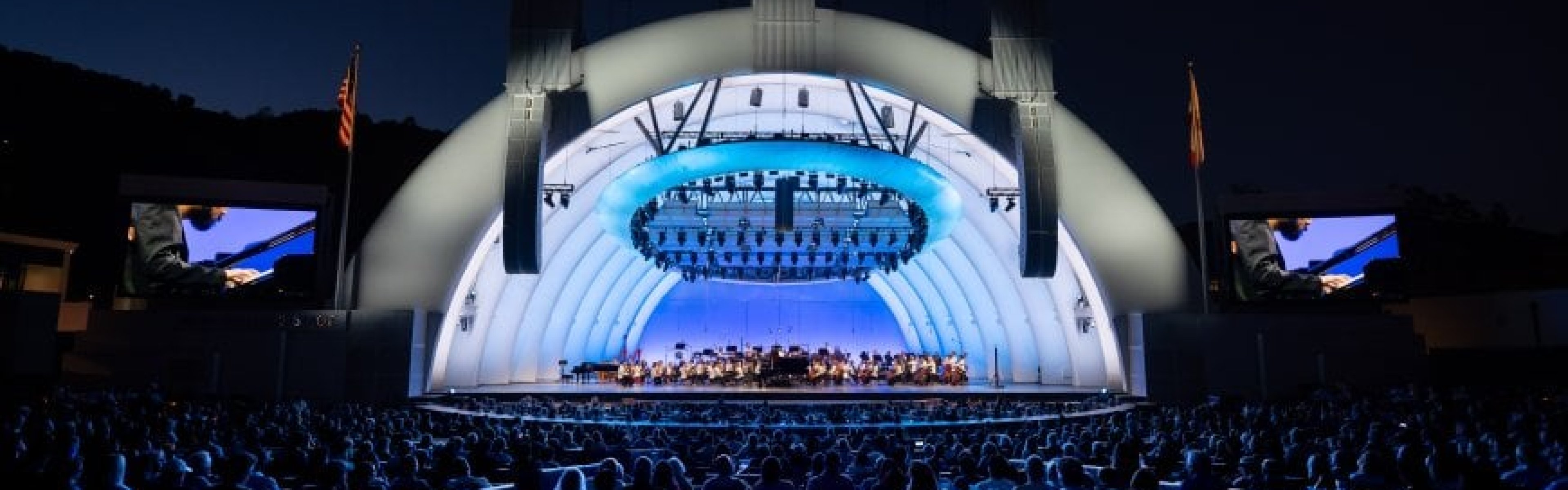
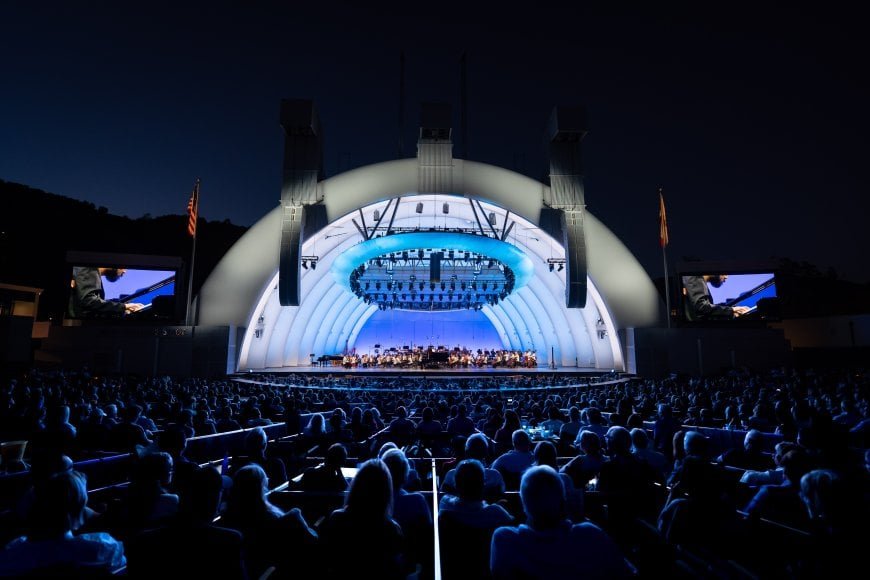
On Sept. 8, 1937, the Hollywood Bowl held a memorial concert for Beverly Hills resident George Gershwin, who had died two months earlier of a brain tumor at the tragically early age of 38. That concert became a milestone in Bowl history.
I bring it up because on Tuesday night, Sept. 1, almost exactly 89 years later, the Bowl held what amounted to an informal memorial — though not advertised as such — for another Los Angeles-based composer, Sarah Gibson, who died prematurely of cancer in 2024 at the age of 38. Despite the huge advances in medicine over that span of time, sadly, we apparently still don’t know much about cancer.
Gibson was a familiar figure in Los Angeles music life — a dedicated teacher, a core member of Piano Spheres alongside Thomas Kotcheff (her partner in the piano duo HOCKET), a composer whose orchestral works were just beginning to gain traction outside Southern California. Not long after giving birth to her first child and receiving the cancer diagnosis, she began working on what turned out to be her last composition, beyond the beyond, a BBC Proms commission. She nearly completed the piece but died before she could finish, so Kotcheff stepped in to “put the finishing touches” on it. The Proms went ahead without it, and the world premiere landed instead with the BBC Philharmonic in Manchester, England, in March 2025, under Anja Bihlmaier, who then traveled to the Bowl to lead the U.S. premiere Tuesday.

It’s a strikingly effective piece, unmistakably American in its sound and vigor. The dynamic opening, starting with streaks of violins and rhythmic knocking, creates a thrumming energy and momentum, interrupted by a very quiet middle section. Here, the brass players are told to breathe through their instruments, simulating, according to Bihlmaier, a soft lullaby to Gibson’s baby son. Soon the pulse revs up again with cascades throughout the orchestra, leading to a sparse yet still driving coda. Like Gershwin’s Porgy and Bess, though on a much smaller scale (only nine minutes and change in length), beyond the beyond is the last large statement of a composer who didn’t get another, and it leaves us hanging with the unanswerable question of what-might-have-been.
The South Korean violinist Bomsori Kim — now billed simply as Bomsori — took to the Bowl stage next in Max Bruch’s ever-popular virtuoso turn, the Violin Concerto No. 1. Brandishing her ability to overcome all technical challenges, Bomsori took an aggressive approach to the outer movements, sporting a cuttingly acidic tone and a nice, even vibrato. Yet one can’t really put the onus on Bomsori for that tone, since other violin soloists whom I’ve heard at the Bowl this year have exhibited the same problem. Nor on Bihlmaier’s conducting, for that matter.
Under Bihlmaier, the concluding Dvořák Symphony No. 8 rumbled through the Bowl brusquely and crisply, with an edge that would make you wonder why this piece has been called Dvořák’s “pastoral symphony.” You wouldn’t expect a true bucolic Czech flavor from an American orchestra, but still, it doesn’t have to be as blatantly in-your-face as this.
Nor is it just the soloists. The LA Phil string section has often sounded rather strident this summer, and so did the strings of the National Symphony Orchestra of Washington, D.C., in a one-off NSO concert at the Bowl two weeks before (Aug. 18).
I have to conclude tentatively that it’s the fault of the Bowl’s new L-Acoustics 3D “immersive” AI-assisted sound system and/or the engineers controlling it. The violin sections sound harsh when pushed (I noticed Tuesday that each violinist’s instrument had a mic attached to it). The overall volume level is considerably higher than it was in previous summers; indeed, the loud portions of symphonic music are almost deafening now. While the miking reveals lots of detail, some of the spotlighting of instruments is exaggerated, and there is a peak in the lower middle-range that is sometimes ballooned up to such a high level that it almost feeds back. From the vantage point of the box seats, the vaunted surround-sound capabilities of the system could only be detected if you cupped your ears with your palms facing backwards; otherwise, the sound always comes straight at you from the front.
One wonders whether this sonic onslaught can be attributed to a desire to please contemporary audiences raised on rock concerts, deafening sound levels in movie multiplexes, and the steadily increasing ambient levels of everyday life. If this is the way it’s gonna be from now on, I may have to spend the rest of my days bringing earplugs to classical concerts at the Bowl.