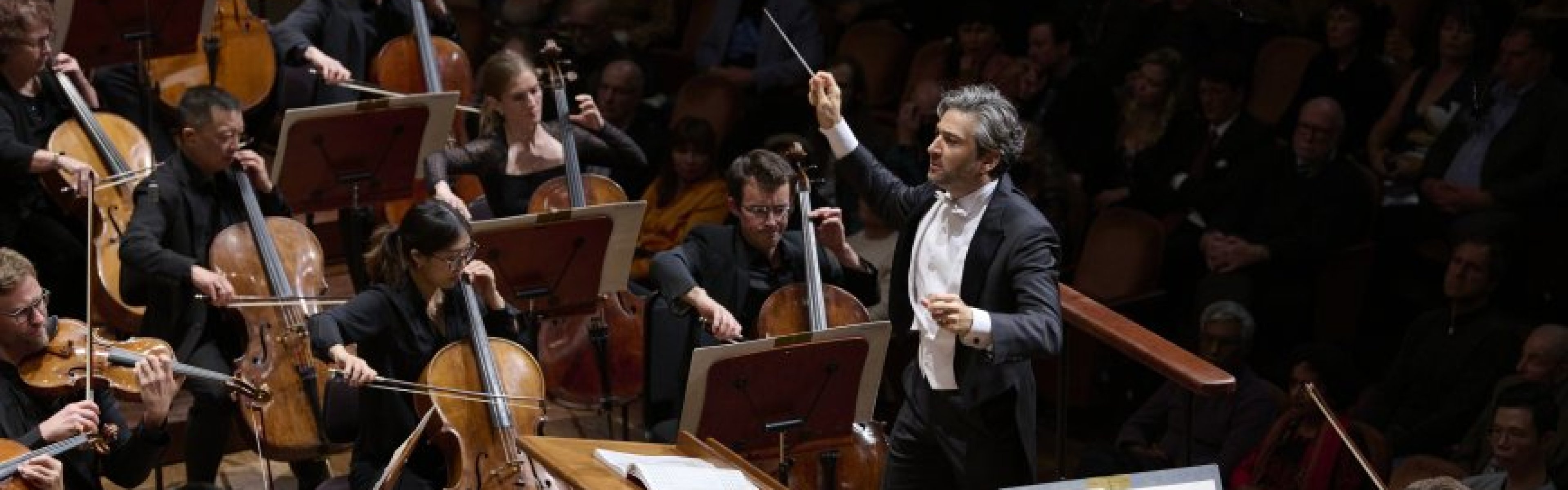
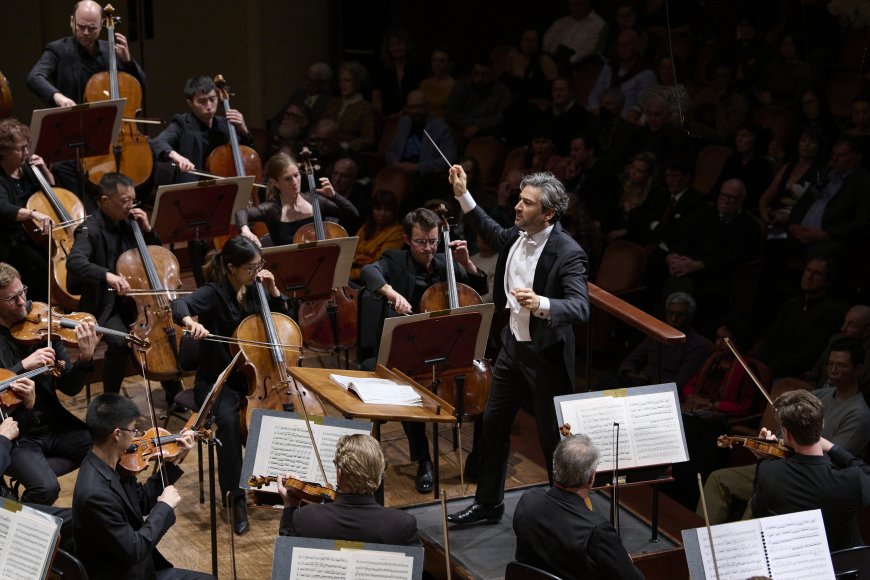
German conductor David Afkham begins his fall season guesting at the San Francisco Symphony’s season-opening subscription concerts on Sept. 18-19,with a program that also features pianist Garrick Ohlsson. It will be the 43-year-old Afkham’s first season after the longest engagement of his career, 12 years at the helm of the Orquesta y Coro Nacional de España, whom he presented in a debut at the BBC Proms in July of this year.
Two decades ago, Afkham was the first recipient of the Bernard Haitink Fund for Young Talent, inaugurating a deep friendship and international experience with the veteran conductor. In 2008, Afkham won first prize at the Donatella Flick Conducting Competition and subsequently became assistant conductor of the London Symphony Orchestra. He has led orchestral and operatic performances in Europe and the U.S. Of his San Francisco debut last October, SF Classical Voice’s Steven Winn praised his “keen and balanced reading of the score.” Elegant even in casual clothing off the podium, Afkham spoke with SFCV last week from a home in Bavaria he shares with his wife, soprano Christiane Karg, and their two small children.
I understand that you were raised in Freiburg, in the Black Forest, in a large family with strong musical values.
My father was a medical doctor and my mother comes from finance, but they both love music. I was the youngest of five: three of us are professional musicians and two of us are doctors. But we all learned, when we were five or six years old, to play one or two instruments. I saw my brother and sisters going to music class or to the orchestra, and I just went with them. We were surrounded by art and music and culture, which I’m very grateful to my parents that they did that. And now that we have our own two little kids, it’s very important for us to give them the same kind of values we were given.
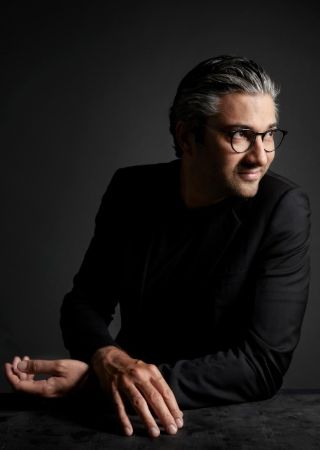
Was your early exposure primarily to Western classical music?
Well, it’s funny you ask, because it was a mix. My mother, who’s German, from her side had the love of classical music. My father is originally from Iran, but as a little child, his parents moved to Mumbai. And though he’s always been interested in classical music, he loves Bollywood music as well.
With all that instrumental activity among your siblings, how long did it take to make your way to conducting?
At first, with the violin, I was concertmaster in different school orchestras, with one of which I traveled to the U.S. As a pianist, I did a lot of competitions. But I felt alone with just the piano. In my teens, at the musikhochschule [conservatory] in Freiburg, I had my first lessons in conducting. When you’re in front of an orchestra and you get, for the first time, this contact with this sound flowing through you, you feel the energy between the musicians, and you can share the emotion and shape it — you get passionate about it. And I could not stop from that point on, it was clear that if I continued with music, it had to be conducting.
You spoke in an interview with Wynne Delacoma about the particular influence of the late Bernard Haitink, and you remarked on his “leading everybody from inside.”
He was my mentor. I met him at a master class in Switzerland, and then he invited me to be his assistant in London. I joined him with the Chicago Symphony Orchestra, where he was like a musical father to me. I tried to learn this idea of leading from the inside, which means it’s not about showing big gestures and jumping into the air and sweating. It’s not about me, it’s trying to do the best for the composer, for the music. It’s an exchange of energy where even the smallest movements have a strong impact. It’s so much more honest; you’re primus inter pares.
Say a bit about your experience with Gustavo Dudamel, who presents differently on the podium.
I was one of the first Dudamel Fellows when Gustavo started in L.A., and I did also the year after [2009- 2010]. Gustavo has a high emotional intelligence, and also a lighter approach — there’s a smile in what he does, even when it’s very serious. He’s really clever, but he’s doing it naturally, nothing artificial.
What was it like settling in for the long run in Spain, in 2014?
I felt a beautiful energy, from nice people. The orchestra had played a lot of German and Central European repertoire, something I had grown up with. But they also had a certain flexibility, because of the Spanish repertoire, which is very colorful and not easy to play because it’s so spontaneous. I had to build on that and to get bigger repertoire, including opera, because they had never really played opera. So I started to do concert versions and semistaged versions of operas. My goal had been to stay for ten years, but because of COVID, we’d had to change a lot of programming, so I said, let’s have two more years. They wanted to have me longer, but I had to leave at the best moment.
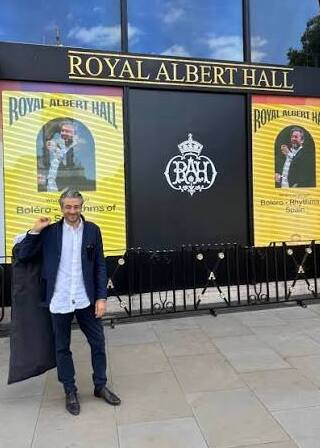
And that moment was making it to the BBC Proms this year?
Yes, absolutely, because it was the debut for the orchestra there and also my official debut. We had two wonderful weeks, the first with the [Benjamin] Britten War Requiem and the second was Gustav Mahler’s Ninth Symphony, the conclusion of a cycle for us. And for the Proms extra concert, we played Spanish music. And the funny thing was, this was the same time when Spain played Argentina in the football World Cup and won! It was a big celebration, I had one eye laughing and one eye crying.
But you haven’t said goodbye to Spain forever.
No, my new season has me coming back to the Orquesta Nacional in October, and I will be a regular guest, so there’s good energy. I’ll be in a different position: Since I’m not in charge anymore, I can be maybe more relaxed. (No, that’s a joke.) I’ll also be meeting new orchestras I have not worked with, in Poland, and I’ll be coming back to the Deutsche Sinfonieorchester in Berlin. And first, I’m very much looking forward to coming to San Francisco.
As a pair of performing parents, do you and Christiane coordinate your seasons?
We discuss musical ideas and programs, but in a very relaxed way. I understand her job very well, and she understands mine. But we also have two little kids, five and seven, and that’s the most important thing in life. We have to discuss all the projects, so that there’s one of us at home. And I want to be a dad: I want to be there when my little daughter is learning to ride a bike.
How does your San Francisco Symphony program resonate for you?
To pair Brahms’s D Minor Piano Concerto with [Robert] Schumann’s D Minor Symphony is a wonderful combination. There’s the friendship between these two composers, and they’re two pillars of my musical life. I’ve never performed with Garrick Ohlsson, but you need one of the greatest pianists for the Brahms. Then I thought it would be nice to have something more contemporary, and Unsuk Chin’s subito con forza is a nice pairing, because it’s a reference to Beethoven. [The title of the piece, composed in 2020 for the Beethoven 250th anniversary year, refers to an instruction frequently found in his compositions,] And I see Brahms and Schumann as kind of a continuation of the genius of Beethoven.
Are you looking forward to more freedom in touring?
In the end, we are all family, and we are all connected through music. To meet different cultures with different languages in different cities is a value I really don’t want to miss. It opens something in our minds and in our hearts which I wish more people could discover, because in the end, we’re all the same.